Use the labels in the right column to find what you want. Or you can go thru them one by one, there are only 33,849 posts. Searching is done in the search box in upper left corner. I blog on anything to do with stroke. DO NOT DO ANYTHING SUGGESTED HERE AS I AM NOT MEDICALLY TRAINED, YOUR DOCTOR IS, LISTEN TO THEM. BUT I BET THEY DON'T KNOW HOW TO GET YOU 100% RECOVERED. I DON'T EITHER BUT HAVE PLENTY OF QUESTIONS FOR YOUR DOCTOR TO ANSWER.
Changing stroke rehab and research worldwide now.Time is Brain!trillions and trillions of neuronsthatDIEeach day because there areNOeffective hyperacute therapies besides tPA(only 12% effective). I have 523 posts on hyperacute therapy, enough for researchers to spend decades proving them out. These are my personal ideas and blog on stroke rehabilitation and stroke research. Do not attempt any of these without checking with your medical provider. Unless you join me in agitating, when you need these therapies they won't be there.
What this blog is for:
My blog is not to help survivors recover, it is to have the 10 million yearly stroke survivors light fires underneath their doctors, stroke hospitals and stroke researchers to get stroke solved. 100% recovery. The stroke medical world is completely failing at that goal, they don't even have it as a goal. Shortly after getting out of the hospital and getting NO information on the process or protocols of stroke rehabilitation and recovery I started searching on the internet and found that no other survivor received useful information. This is an attempt to cover all stroke rehabilitation information that should be readily available to survivors so they can talk with informed knowledge to their medical staff. It lays out what needs to be done to get stroke survivors closer to 100% recovery. It's quite disgusting that this information is not available from every stroke association and doctors group.
I have a mild case of sleep apnea (6.5
times an hour), use of a CPAP makes it impossible for me to sleep. My
doctor
never considered my exhaustion could be sleep apnea rather than the
stroke, but then he never knew anything about stroke either. I quit
using it so I could actually sleep, no clue if it still exists, no
partner to tell me otherwise.
The purpose of this study is to determine whether treatment of obstructive sleep apnea (OSA) with positive airway pressure starting shortly after acute ischemic stroke (1) reduces recurrent stroke, acute coronary syndrome, and all-cause mortality 6 months after the event, and (2) improves stroke outcomes at 3 months in patients who experienced an ischemic stroke.
To learn more, visit ClinicalTrials.govontacts and Locations
Contact Information
Study Contact
NameKayla Novitski, MPH, CCRP
PhoneNot available
Emailkcgossel@med.umich.edu
Study Contact Backup
NameJoelle Sickler, MSN, CCRC, CCRA
PhoneNot available
Emailsicklejb@ucmail.uc.edu
United States Locations
Alabama
Birmingham, Alabama, United States 35294 University of Alabama Hospital
Arizona
Chandler, Arizona, United States 85224 Chandler Regional Medical Center
Phoenix, Arizona, United States 85006
Banner University Medical Center Phoenix
Phoenix, Arizona, United States 85013
Dignity Health - St. Joseph's Hospital and Medical Center
Tucson, Arizona, United States 85712
TMC Healthcare
Tucson, Arizona, United States 85719
Banner- University Medical Center Tucson
California
Carmichael, California, United States 95608
Mercy San Juan Medical Center
Downey, California, United States 90242
Rancho Los Amigos National Rehabilitation Center
La Jolla, California, United States 92037
Scripps Memorial
La Jolla, California, United States 92103
UCSD Health La Jolla
Los Angeles, California, United States 90048
Cedars-Sinai Medical Center
Los Angeles, California, United States 90095
Ronald Reagan UCLA Medical Center
Los Angeles, California, United States 94612
Kaiser Permanente Los Angeles
Modesto, California, United States 95355
Doctors Medical Center of Modesto
Ontario, California, United States 91761
UCLA Kaiser Fontana
Orange, California, United States 92868
UC Irvine
Pomona, California, United States 91767
Casa Colina
Redwood City, California, United States 94063
Kaiser Redwood
Sacramento, California, United States 95817
UC Davis Medical Center
San Diego, California, United States 92103
UCSD Medical Center - Hillcrest Hospital
San Francisco, California, United States 94143
UCSF Helen Diller Medical Center at Parnassus Heights
Santa Ana, California, United States 92705
Orange County Global Medical Center
Sylmar, California, United States 91342
Olive View- UCLA Medical Center
Walnut Creek, California, United States 94598
John Muir Medical Center- Walnut Creek Campus
Colorado
Grand Junction, Colorado, United States 81501
St. Mary's Hospital and Medical Center
Connecticut
Hartford, Connecticut, United States 06102
Hartford Hospital
New Haven, Connecticut, United States 06510
Yale-New Haven Hospital
District of Columbia
Washington D.C., District of Columbia, United States 20037
George Washington University Hospital
Florida
Clearwater, Florida, United States 33756
Morton Plant Hospital
Fort Lauderdale, Florida, United States 33305
Broward Health
Gainesville, Florida, United States 32611
UF Health Shands Hospital
Jacksonville, Florida, United States 32209
UF Jacksonville
Jacksonville, Florida, United States 32216
Brooks Rehabilitation Hospital
Miami, Florida, United States 33136
Jackson Memorial Hospital
Miami, Florida, United States 33176
Baptist Hospital of Miami
Sarasota, Florida, United States 34239
Sarasota Memorial Hospital
Tampa, Florida, United States 33606
Tampa General Hospital
Tampa, Florida, United States 33607
St. Joseph's Hospital
Georgia
Atlanta, Georgia, United States 30303
Grady Memorial Hospital
Illinois
Chicago, Illinois, United States 60612
Rush University Medical Center
Chicago, Illinois, United States 60612
University of Illinois Hospital and Health Sciences System
Chicago, Illinois, United States 60637
University of Chicago
Peoria, Illinois, United States 61603
OSF Saint Francis Medical Center
Springfield, Illinois, United States 62702
Memorial Medical Center
Iowa
Des Moines, Iowa, United States 50309
Iowa Methodist
Iowa City, Iowa, United States 52242
University of Iowa Hospitals and Clinics
Kentucky
Louisville, Kentucky, United States 40218
Norton HealthCare
Louisiana
New Orleans, Louisiana, United States 70121
Ochsner Medical Center - Main Campus
Shreveport, Louisiana, United States 71103
University Health Shreveport
Maryland
Baltimore, Maryland, United States 21201
University of Maryland
Massachusetts
Boston, Massachusetts, United States 02111
Tufts Medical Center
Boston, Massachusetts, United States 02114
Massachusetts General Hospital
Boston, Massachusetts, United States 02215
Beth Israel Deaconess Medical Center
Worcester, Massachusetts, United States 01655
UMass Memorial Medical Center,
Michigan
Detroit, Michigan, United States 48202
Henry Ford Hospital
Flint, Michigan, United States 48532
McLaren Flint
Grand Rapids, Michigan, United States 49503
Trinity Health Saint Mary's
Kalamazoo, Michigan, United States 49008
Bronson Methodist Hospital
Minnesota
Rochester, Minnesota, United States 55905
Mayo Clinic Saint Marys Campus
Saint Cloud, Minnesota, United States 56303
Saint Cloud/Centracare Health
Mississippi
Jackson, Mississippi, United States 39216
University of Mississippi Medical Center
Missouri
Kansas City, Missouri, United States 64111
Saint Luke's Hospital of Kansas City
Springfield, Missouri, United States 65807
Cox Medical Center
St Louis, Missouri, United States 63110
Barnes-Jewish Hospital
Nebraska
Omaha, Nebraska, United States 68198
University of Nebraska Medical Center
New Jersey
Edison, New Jersey, United States 08820
JFK Neuroscience Institute
Livingston, New Jersey, United States 07039
Cooperman Barnabas Medical Center
Neptune City, New Jersey, United States 07753
Hackensack Meridian Jersey Shore University Medical Center
New Mexico
Albuquerque, New Mexico, United States 87106
University of New Mexico Hospital
New York
Brooklyn, New York, United States 11219
Maimonides Medical Center
Brooklyn, New York, United States 11220
NYU Langone Brooklyn
Buffalo, New York, United States 14203
Buffalo General Medical Center
Manhasset, New York, United States 11030
North Shore University Hospital
New York, New York, United States 10016
Bellevue Hospital
New York, New York, United States 10016
NYU Langone -Tish Hospital Medical Center
New York, New York, United States 10032
NYP Columbia University Medical Center
Rochester, New York, United States 14642
Strong Memorial Hospital
Staten Island, New York, United States 10305
Staten Island University Hospital
Syracuse, New York, United States 13210
Suny Upstate Medical University
The Bronx, New York, United States 10467
Montefiore Medical Center
North Carolina
Charlotte, North Carolina, United States 28203
Carolinas Medical Center Atrium Health
Concord, North Carolina, United States 28025
Carolinas Rehab Northeast
Greensboro, North Carolina, United States 27401
Guilford Neurologic Associates, Inc
Winston-Salem, North Carolina, United States 27157
Wake Forest University Baptist Medical Center
Ohio
Cincinnati, Ohio, United States 45219
Christ Hospital
Cincinnati, Ohio, United States 45219
University of Cincinnati Medical Center
Cleveland, Ohio, United States 11100
UH Cleveland Medical Center
Cleveland, Ohio, United States 44195
Cleveland Clinic
Columbus, Ohio, United States 43210
OSU Wexner Medical Center
West Chester, Ohio, United States 45069
West Chester Hospital
Oklahoma
Tulsa, Oklahoma, United States 74104
St. John Health System
Oregon
Portland, Oregon, United States 97225
Providence St. Vincent Medical Center
Pennsylvania
Bethlehem, Pennsylvania, United States 18015
St. Luke's University Hospital Bethlehem Campus
Danville, Pennsylvania, United States 17822
Geisinger Clinic
Hershey, Pennsylvania, United States 17033
Penn State Milton S. Hershey Center
Philadelphia, Pennsylvania, United States 19104
Hospital of the University of Pennsylvania
Philadelphia, Pennsylvania, United States 19122
Temple University Hospital
Pittsburgh, Pennsylvania, United States 15213
UPMC Presbyterian Hospital
South Carolina
Columbia, South Carolina, United States 29203
Palmetto Health Richland
Greenville, South Carolina, United States 29605
Greenville Memorial Hospital
South Dakota
Sioux Falls, South Dakota, United States 57108
Avera Research Institute
Tennessee
Knoxville, Tennessee, United States 37916
Fort Sanders Regional Medical Center
Memphis, Tennessee, United States 38105
Methodist University
Texas
Dallas, Texas, United States 75246
Baylor Scott & White Institute of Rehabilitation
Houston, Texas, United States 77030
Memorial Hermann Texas Medical Center
Utah
Murray, Utah, United States 84107
Intermountain Medical Center
Salt Lake City, Utah, United States 84132
University of Utah Healthcare
Vermont
Burlington, Vermont, United States 05401
The University of Vermont Medical Center Main Campus
Virginia
Charlottesville, Virginia, United States 22908
UVA Medical Center
Falls Church, Virginia, United States 22042
Inova Fairfax
Richmond, Virginia, United States 23219
Virginia Commonwealth University
Washington
Seattle, Washington, United States 98101
Virginia Mason Medical Center
Seattle, Washington, United States 98195
Harborview Medical Center
West Virginia
Morgantown, West Virginia, United States 26506
Ruby Memorial Hospital
Wisconsin
La Crosse, Wisconsin, United States 54601
Gundersen Lutheran Medical Foundation
Madison, Wisconsin, United States 53715
University of Wisconsin University Hospital
Participation CriteriaEligibility CriteriaCurrent Inclusion Criteria, as of 6/28/2024:Ischemic stroke within the prior 7 days.
NIH Stroke Scale Score ≥1 at the time of enrollment
Previous Inclusion Criteria, prior to 6/28/2024:
1. Ischemic stroke or TIA with ABCD ≥4, within prior 14 days.
Exclusion Criteria (for entire time period):
pre-event inability to perform all of own basic ADLs
unable to obtain informed consent from subject or legally authorized representative
incarcerated
known pregnancy
current mechanical ventilation (can enroll later if this resolves) or tracheostomy
current use of positive airway pressure, or use within one month prior to stroke
anatomical or dermatologic anomaly that makes use of CPAP interface unfeasible
severe bullous lung disease
history of prior spontaneous pneumothorax or current pneumothorax
hypotension requiring current treatment with pressors (can enroll later if this resolves)
other specific medical circumstances that conceivably, in the opinion of the site PI, could render the patient at risk of harm from use of CPAP
massive epistaxis or previous history of massive epistaxis
cranial surgery or head trauma within the past 6 months, with known or possible CSF leak or pneumocephalus
recent hemicraniectomy or suboccipital craniectomy (i.e. those whose bone has not yet been replaced), or any other recent bone removal procedure for relief of intracranial pressure
current receipt of oxygen supplementation >4 liters per minute
current contact, droplet, respiratory/airborne precautions
Introduction Stroke is a leading cause of long-term disability worldwide, often resulting in persistent limitations in activity and participation. Measuring the degree of handicap experienced by stroke survivors is essential for guiding rehabilitation, monitoring progress, and evaluating outcomes. The London Handicap Scale (LHS) is a widely used tool for assessing participation restrictions; however, its application requires cultural and linguistic adaptation to ensure validity in non-English-speaking populations. Given the large Hausa-speaking population in West Africa, a culturally adapted version of the LHS is needed to support clinical practice and research.
Aims To cross-culturally adapt the London Handicap Scale (LHS) into the Hausa language and to evaluate its psychometric properties among stroke survivors.
Material and methods The cross-cultural adaptation of the LHS was performed in accordance with the American Association of Orthopaedic Surgeons (AAOS) guidelines. The psychometric properties of the final Hausa version (LHS-H)—including test–retest reliability, criterion validity, internal consistency, and construct validity—were assessed among stroke survivors. Socio-demographic characteristics were summarized using descriptive statistics. Reliability and validity analyses were conducted using Spearman rank-order correlation, Cronbach’s alpha, and confirmatory factor analysis, with statistical significance set at α = 0.05.
This is the whole problem in stroke enumerated in one word; 'care'; NOT RECOVERY!
Our non-existent stroke leadership should be demanding RECOVERY NOT 'CARE'!
My god, anyone in the business world would
be fired immediately for managing or caring about something rather than
delivering RESULTS. And this is why this is a complete fucking
failure! This does nothing to guarantee recovery for survivors!
If
your stroke medical 'professional'/hospital is touting 'care' it means they are a failure because
they are delivering 'care'; NOT RECOVERY! I would never go to a failed
hospital! Anytime I see the word 'care' associated with a stroke
hospital; I immediately think fucking failure!
YOU have to get involved and change this failure mindset of 'care' to 100% RECOVERY! Survivors want RECOVERY, NOT 'CARE'!
I see nothing here that states going for 100% recovery! You need to create EXACT PROTOCOLS FOR THAT!
ASK SURVIVORS WHAT THEY WANT, THEY'LL NEVER RESPOND 'CARE'! This
tyranny of low expectations has to be completely rooted out of any
stroke conversation! I wouldn't go there because of such incompetency as
not having 100% recovery protocols!
Discover how Sweden has developed their life after stroke care(NOT RECOVERY!). Professors Bo Norrving and Mia von Euler will share insights into successes in organising and monitoring care(NOT RECOVERY!) nationally, while stroke survivors Annelie Heikenborn and Helen Palmqvist Novik will highlight the power of patient advocacy, follow-up and support in recovery. With the wrong goal; EVERYTHING HERE IS DOOMED TO FAILURE! Survivors want recovery, NOT 'CARE'! Have you never talked to a survivor without talking them down to your tyranny of low expectations?
Ask your competent? doctor if this will recover your 5 lost years of brain cognition due to your stroke?
No knowledge, that is pure incompetence! I take no prisoners in trying
to force our stroke medical 'professionals' to actually solve stroke to
100% recovery!
Ask your competent? doctor if this will recover your 5 lost years of brain cognition due to your stroke? No knowledge, that is pure incompetence! I take no prisoners in trying to force our stroke medical 'professionals' to actually solve stroke to 100% recovery!
But why go thru all the trouble of stem
cells if exosomes are the reason for the benefits? Which must be why no
one seems to be monitoring stem cell survival.
Globally, stroke stands as a principal cause of death and
disability, presenting formidable challenges in rehabilitation.
Conventional therapeutic modalities often fail to restore functional
capabilities fully, underscoring the need for innovative treatment
strategies. Stem cell therapy emerges as a revolutionary approach,
capitalizing on the regenerative capabilities of stem cells to improve
neurological function poststroke. This review evaluates the roles of
various stem cell types—mesenchymal stem cells (MSCs), neural stem cells
(NSCs), and induced pluripotent stem cells (iPSCs)—in the realm of
stroke recovery. It elucidates their distinct biological mechanisms,
evaluates their therapeutic impact based on clinical trial data, and
discusses their efficacy in fostering neural repair and recovery. MSCs
are particularly noted for their role in immunomodulation and promotion
of angiogenesis and neurogenesis, with clinical evidence supporting
their safety and effectiveness in stroke recovery. NSCs are lauded for
their ability to differentiate into diverse neural lineages. They
integrate into neural circuits to enhance synaptic connectivity and
neuroplasticity. iPSCs, known for their versatility, can be tailored to
patient-specific needs and are shown in preclinical settings to reduce
infarct size and promote the survival of neuronal cells. However, the
field grapples with challenges, including optimizing stem cell
transplantation timing, precision in cell delivery, integration
efficiency, and immune system compatibility. These issues call for
harmonization of methodologies across ongoing studies to ensure the
reliability and consistency of therapeutic outcomes. This review
highlights the promising future and challenges of stem cell therapy for
treatment of stroke.
Have your competent? doctor verify that your body clock is still functioning post stroke and have EXACT PROTOCOLS to fix it if needed! A competent doctor would have these interventions already on hand! Your doctor should have the Body Clock test already in hand, IF COMPETENT AT ALL!
If your doctor hasn't created EXACT MUSIC THERAPY protocols, THAT IS COMPLETE INCOMPETENCE FOR AT LEAST A DECADE! So, you DON'T have a functioning stroke doctor, do you?
Music has a remarkable ability to reach parts of the brain that other therapies cannot. For brain injury survivors, the right songs can help rebuild neural pathways, improve motor skills, enhance cognitive function, support speech recovery, and provide emotional comfort during rehabilitation.
In this article, we give you our 50 best songs ranging from uplifting anthems to calming songs to reduce stress so you can start your new year recovery journey with the right tune!
Tap a link to jump directly to a section: Best Motivating Songs for Brain Injury Best Calming Songs for Stress Relief Best High Energy Songs for Brain Injury Recovery Best Songs That Encourage Hope After Brain InjuryWhy Music Matters in Brain Injury Recovery
Research shows that music therapy can significantly aid traumatic brain injury (TBI) rehabilitation. Rhythmic patterns help retrain motor movements, familiar melodies can assist with memory recall and speech recovery, and emotional connections to songs provide motivation during challenging therapy sessions. The songs we’ve selected offer a mix of tempos, emotional resonance, and lyrical inspiration to support different aspects of your recovery. We also tried to consider a broad range of genres and eras to give everybody something they can use. While every individual has different tastes in what music they listen to, this will give you a good starting point for creating your recovery playlist!Learn more about Music Therapy for Traumatic Brain Injury Best Motivating Songs for Brain Injury Music has a way of saying what we can’t always put into words. These motivating songs for brain injury can help lift your mood, remind you of your strength, and give you a steady rhythm to move, stretch, or simply breathe along with. Let’s jump in!
1. “Survivor” by Destiny’s Child
Artist: Destiny’s Child This song feels like a pep talk from friends who believe in you. It celebrates strength, grit, and the decision to keep going, even when life feels heavy. The clear vocals make it easier to follow along, and the upbeat rhythm works great for therapy exercises. Each chorus becomes a reminder: you’re still here, and you’re moving forward.
2. “Don’t Stop Believin'” by Journey
A true classic for staying hopeful. The steady beat can help guide walking or arm movements, and the familiar melody is easy to hum or sing along with. When recovery feels slow, this song gently reminds you that the story isn’t over and there’s still so much ahead.
3. “Lose Yourself” by Eminem
“Lose Yourself” captures that feeling of having one chance and wanting to make it count. The driving beat pulls you in right away, making it great for movement, exercise, or moments when you need extra determination. For tough rehab days, its message about pushing through fear and staying present can be exactly the push you need to keep going.
4. “Roar” by Katy Perry
Artist: Katy Perry “Roar” is all about discovering your voice again. For anyone rebuilding confidence or working on speech, the clear lyrics and positive message make it especially encouraging. The steady rhythm also pairs nicely with coordination or movement exercises. It’s like an anthem for finding your inner strength.
5. “Fight Song” by Rachel Platten
Artist: Rachel Platten This track is like a reminder that even small steps count. The lyrics speak to finding your strength again, especially when you feel tired or discouraged. The simple melody is easy to follow, and the gradual build of the song can mirror the feeling of progress during recovery.
6. “Stronger (What Doesn’t Kill You)” by Kelly Clarkson
Artist: Kelly Clarkson This song is all about rebuilding confidence after something life-changing. The upbeat tempo makes it great for movement, and the chorus can feel like a personal reminder that every challenge is helping you grow. The clear lyrics are easy to follow, and the message encourages perseverance, especially on days when progress feels slow.
7. “Shake It Off” by Taylor Swift
Artist: Taylor Swift This pop hit encourages both literal and metaphorical shaking off of setbacks. The steady beat supports rhythmic movement exercises, while the lyrics remind you not to dwell on frustrations common during brain injury recovery. In addition, the catchy melody makes it memorable for cognitive exercises.
8. “Brave” by Sara Bareilles
Artist: Sara Bareilles “Brave” encourages honesty, courage, and speaking up, even when it feels scary. For brain injury survivors working on communication or confidence, the message is powerful. The upbeat tempo also makes it a fun companion for light exercise or morning motivation.
9. “Unwritten” by Natasha Bedingfield
Artist: Natasha Bedingfield “Unwritten” feels like opening a brand-new chapter. The lyrics celebrate fresh starts and remind you that your story isn’t finished yet, even if life looks different than before. For many brain injury survivors, the idea of blank pages and new beginnings can feel both emotional and empowering. The upbeat rhythm brings energy back into the moment, making it a great song to play during therapy, movement, or anytime you need a boost of motivation.
10. “I Will Survive” by Gloria Gaynor
Artist: Gloria Gaynor “I Will Survive” is more than just a disco hit. It’s a declaration of resilience. The steady, danceable beat makes it easy to move along, whether that means gentle steps, stretching, or simple rhythm exercises. The lyrics celebrate finding strength after hardship, which can feel especially meaningful for brain injury survivors rebuilding independence and rediscovering who they are. It’s uplifting, empowering, and hard not to smile while listening.
11. “Stronger” by Kanye West
Artist: Kanye West Packed with determination and intensity, this song repeats a powerful idea: pushing through tough moments can help you come back even more resilient. The steady electronic beat is great for pacing movement or exercise, and the repeating chorus makes it easy to follow along. It can be especially motivating on days when you need a little extra drive to keep going.
12. “Scars to Your Beautiful” by Alessia Cara
Artist: Alessia Cara “Scars to Your Beautiful” gently reminds listeners that worth isn’t defined by appearance, ability, or changes that happened after injury. The message about accepting imperfections and honoring who you are right now can feel especially comforting for brain injury survivors adjusting to a new version of themselves. It’s encouraging, honest, and deeply reassuring.
Best Calming Songs for Stress Relief During Brain Injury Recovery
When stress builds up, it can feel like your mind and body are holding on too tightly. Music can help loosen that grip, especially on days when recovery feels overwhelming.. The following songs invite you to slow down, breathe, and give yourself a moment of ease.
13. “Weightless” by Marconi Union
Artist: Marconi Union
Listening to “Weightless” feels like drifting on calm water. It was created specifically to help reduce anxiety, and many people notice their breathing and heart rate gently slowing as they listen. This makes it perfect for quiet breaks, guided relaxation, or unwinding after therapy sessions.
14. “The Scientist” by Coldplay
Artist: Coldplay
“The Scientist” carries a quiet honesty that many people connect with. The song talks about wishing you could go back, start over, and figure things out again, which can feel very familiar during recovery. Instead of pushing the listener, it simply sits with those feelings. The calm piano pattern keeps the brain engaged without feeling overwhelming, making it a comforting choice for quieter moments of reflection.
15. “Somewhere Over the Rainbow” by Israel Kamakawiwo’ole
Artist: Israel Kamakawiwo’ole
The soft ukulele and gentle vocals in this song create an instant feeling of comfort. The slower tempo makes it ideal for deep breathing or stretching, and the hopeful message encourages you to picture brighter days ahead. It’s like a musical reminder that difficult seasons do eventually pass.
16. “Blackbird” by The Beatles
Artist: The Beatles
This quiet, acoustic song feels both peaceful and uplifting. The fingerpicking guitar and thoughtful lyrics speak to healing, resilience, and learning to rise again. For many people in recovery, that message feels deeply relatable while still keeping the mood soft and relaxing.
17. “Three Little Birds” by Bob Marley
Artist: Bob Marley
With its laid-back reggae beat, this song is an incredible reminder to not carry every worry on your shoulders. The repeating line, “every little thing is gonna be alright,” can feel like a gentle voice reminding you to take things one step at a time. It’s calming, but still bright and positive.
18. “Moon River” by Andy Williams
Artist: Andy Williams
Soft, flowing, and deeply peaceful, “Moon River” invites the mind to settle. The nostalgic melody can bring back warm memories, while the overall feel encourages rest and quiet reflection. It’s a wonderful song for winding down at the end of the day.
19. “Landslide” by Fleetwood Mac
Artist: Fleetwood Mac
“Landslide” offers quiet reassurance. The soft guitar and steady rhythm create a calming atmosphere, while the reflective lyrics acknowledge change, vulnerability, and growth. It’s the kind of song that lets you sit with your feelings without rushing them, reminding you that it’s okay to take things slowly and be gentle with yourself along the way.
Best High Energy Songs for Brain Injury Recovery
20. “Firework” by Katy Perry
Artist: Katy Perry
“Firework” is all about realizing that your light hasn’t gone anywhere. The song begins gently and gradually rises into something bold and powerful, which can feel a lot like the recovery process itself. Its message encourages listeners to believe in their own worth, even on days filled with doubt. Many brain injury survivors find the growing intensity uplifting, as if the music is cheering them on to keep moving forward.
21. “Eye of the Tiger” by Survivor
Artist: Survivor
“Eye of the Tiger” has become almost synonymous with courage and determination. The opening beat grabs your attention right away, setting the pace for movement, exercise, or focused therapy work. Its message about staying tough, getting back up, and refusing to quit mirrors the mindset many brain injury survivors develop during recovery. It doesn’t just pump you up, it reminds you that every effort counts.
22. “Living on a Prayer” by Bon Jovi
Artist: Bon Jovi
The anthemic chorus and driving beat create powerful motivation. The message about holding on and not giving up speaks directly to the perseverance required for brain injury recovery. The building energy supports increasing therapy intensity.
23. “Beautiful Day” by U2
Artist: U2
“Beautiful Day” brings light and optimism, even in seasons of change. The uplifting melody and reflective lyrics remind you that life can still hold meaning, connection, and joy after hardship. It doesn’t ignore difficulty — instead, it gently points to what’s still worth noticing and celebrating. Listening feels like opening a window and letting fresh air in.
Songs That Encourage Hope After Brain Injury
24. “Rise Up” by Andra Day
Artist: Andra Day
Day’s powerful vocals and message about perseverance through hardship speak directly to brain injury survivors. The gospel-influenced soul provides emotional depth, and the building intensity supports expressing determination and resilience making it a great song for those that need a little extra hope!
25. “The Climb” – Miley Cyrus
Artist: Miley Cyrus
“The Climb” beautifully captures what recovery often feels like: slow, persistent progress. The lyrics remind you that it isn’t about how fast you get there, but about continuing to move forward, even on tough days. The steady melody is reassuring, offering comfort while still encouraging perseverance. It’s a song that says, “you’re doing the best you can and that matters.”
26. “Ain’t No Mountain High Enough” – Marvin Gaye & Tammi Terrell
Artist: “Ain’t No Mountain High Enough” – Marvin Gaye & Tammi Terrell
This classic bursts with joy and encouragement. The upbeat tempo and call-and-response style make it feel like someone cheering you on from the sidelines. Its message is simple but powerful: obstacles may be big, but support, love, and determination are even bigger. It’s the kind of song that lifts your mood and reminds you that help and hope are always within reach.
27. “Defying Gravity” by Idina Menzel (from Wicked)
Artist: Idina Menzel
“Defying Gravity” is bold and liberating. The soaring vocals and dramatic build encourage you to let go of doubts and step into what’s possible. For anyone in recovery, the idea of breaking free from limitations and learning to trust yourself again can feel incredibly empowering. It’s the kind of song that leaves you feeling taller and braver by the end.
28. “Dog Days Are Over” by Florence + The Machine
Artist: Florence + The Machine
“Dog Days Are Over” bursts with excitement and relief, as if a heavy weight is finally coming off your shoulders. The mix of harp, drums, and soaring vocals creates a rush of energy that feels both joyful and freeing. Its message about tough times fading and brighter days ahead can be incredibly motivating during recovery. As the chorus builds, it encourages movement not just physically, but emotionally and mentally too, reminding you that it’s okay to move forward.
29. “I Lived” by OneRepublic
Artist: OneRepublic
“I Lived” feels like a heartfelt reminder to embrace life, even when it isn’t easy. The lyrics talk about facing challenges, learning from them, and being proud of the effort you gave along the way. For many brain injury survivors, that message rings especially true. The music gradually builds in intensity, creating a sense of momentum that can motivate you to keep going, even during tougher therapy days. It’s hopeful, reflective, and a beautiful way to celebrate progress.
30. “Fast Car” by Tracy Chapman
Artist: Tracy Chapman
“Fast Car” draws you in with its calm guitar and thoughtful storytelling. The song unfolds step by step, which can help the brain follow along and practice sequencing without feeling overloaded. At the same time, the theme of wanting change, dreaming of something better, and working toward a new life can feel deeply relatable during recovery. It’s quiet, steady, and hopeful in a grounded, realistic way.
How to Use This Playlist in Your Recovery
Integrate these songs into different aspects of your rehabilitation routine. Use upbeat tracks during physical therapy sessions to maintain energy and motivation. Choose calming songs for rest periods, meditation, or managing sensory overload and anxiety. Work with speech therapists to incorporate clear-lyric songs into articulation and memory practice. Let emotional ballads help you process feelings about your recovery journey.
Consider creating smaller themed playlists from these 30 songs based on your daily needs: a morning motivation mix, a workout playlist for PT, a calm-down collection for when you feel overstimulated, and a speech and memory practice selection. Rotate songs to prevent cognitive fatigue while maintaining favorites that particularly resonate with you.
Remember that music preference is personal. While these songs offer therapeutic benefits, choose the ones that genuinely speak to you. Your emotional connection to music enhances its healing power and makes therapy more effective.
Recovery from brain injury is a marathon, not a sprint. These 30 songs can serve as companions on your journey, providing rhythm for movement, words for speech practice, stimulation for memory work, and comfort for difficult days. Music therapy research continues to reveal new benefits for neurological recovery, making your playlist a valuable tool alongside traditional rehabilitation methods.
Let these songs remind you that you’re not alone in your recovery. Millions have walked similar paths, finding strength in melody and meaning in lyrics. Each time you play these tracks, you’re engaging your brain in healing work while also caring for your emotional wellbeing.
Your recovery is unique, and so is your relationship with music. Use this playlist as a starting point, but feel free to add personal favorites that hold special meaning for you.
We hope you enjoyed this article and subscribe to our newsletter for weekly articles just like this delivered straight to your inbox — subscribe here.
Statin use decreases vertebrobasilar dissecting aneurysms (VBDA) wall enhancement identified on vessel wall (VW) MRI scans, researchers have found.
The findings offer further evidence that statins reduce stroke risk, wrote a team led by Yisen Zhang, MD, of Beijing Tiantan Hospital and Beijing Neurosurgical Institute at Capital Medical University in China.
"Among patients with unruptured vertebrobasilar dissecting aneurysms, statins reduced aneurysm wall enhancement, reduced the levels of circulating inflammatory biomarkers, and stabilized intramural hematomas," the group noted.
VBDAs are significant causes of stroke, and aneurysm wall enhancement at the vessel wall, as identified on MRI, is a marker of inflammation that suggests vulnerability to VBDAs. Although previous research has shown that statins may reduce inflammation in intracranial saccular aneurysms, their effect on VBDAs has been unclear.
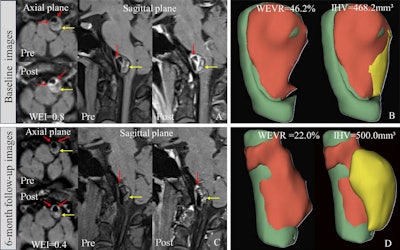
Zhang and colleagues conducted a study that evaluated the effect of a six-month atorvastatin treatment on VBDA wall enhancement as seen on vessel wall MRI scans. The research included 40 participants with unruptured VBDAs between July 2021 and January 2023. Patients were randomized one-to-one into a daily 20 mg atorvastatin group and a control group; all underwent VW MRI at the study start and at six-month follow-up. The primary outcome was any change in aneurysm wall enhancement measured by the quantitative wall enhancement index, or WEI (which evaluates rupture risk of intracranial aneurysms), and three-dimensional wall enhancement volume rate, or WEVR (which evaluates the growth and instability of intracranial or aortic aneurysms). Secondary outcomes were changes in aneurysm size or structure and any inflammation-related biomarkers.In the statin group, both the WEI and WEVR of the aneurysm wall decreased at six months MR imaging compared with those measures at baseline. Between baseline and follow-up, the change in WEI was -0.3 in the statin group and 0.1 in the control group (p < 0.001), while the change in WEVR was -15.1% in the statin group and 5.3% in the control group (p < 0.001). Circulating plasma levels of C-reactive protein, tumor necrosis factor alpha, interleukin-6, and interleukin-1 beta all decreased in the atorvastatin group compared with the control group (all p < 0.05). The atorvastatin group also showed slowed progression of intramural hematoma (304 mm3 compared with 100.3 mm3 in the control group; p = 0.006). Typical statin case presentation. Images were obtained in a 35-year-old woman with a left vertebral artery dissection aneurysm who presented with headache. (A, C) Vessel wall MRI scans show aneurysm wall enhancement. (B, D) Panels show three-dimensional postprocessed images derived from contrast-enhanced T1-weighted MRI scans, illustrating the wall enhancement volume ratio (WEVR) and intramural hematoma volume (IHV) calculated using 3D Slicer (version 5.0.3; Slicer Community, www.slicer.org). (A) Precontrast and postcontrast images in the axial and sagittal planes at baseline MRI show aneurysm wall enhancement, with a wall enhancement index (WEI) of 0.8. (B) Image shows the WEVR and intramural IHV at baseline (WEVR = 46.2%; IHV = 468.2 mm3). (C) Precontrast and postcontrast images in the axial and sagittal planes at the 6-month follow-up show aneurysm wall enhancement, with a WEI of 0.4. (D) Image obtained at the 6-month follow-up (WEVR = 22%; IHV = 500 mm3). The yellow arrows in A and C indicate the intracranial hematoma, and the red arrows indicate wall enhancement. Red areas in B and D show the enhanced wall, green areas highlight the nonenhanced wall, and yellow areas highlight the IHV. RSNA