Saturday, April 27, 2019


Psychostimulant Use and Fatal Stroke in Young Adults
I bet the autopsies don't give enough detail to say exactly what brain cells died and that caused death. Fearmongering in general. Be careful out there.
Psychostimulant Use and Fatal Stroke inYoung Adults
Friday, April 26, 2019
Missed osteoporosis screening puts stroke survivors at fracture risk
Once again addressing a secondary issue rather than fixing the primary problem, reduced mobility, which is addressed by getting survivors 100% recovered.
Missed osteoporosis screening puts stroke survivors at fracture risk
Stroke survivors are at risk for osteoporosis, broken bones or falling. Yet many aren't screened for such dangers, which may increase the odds they'll suffer fractures, a new study says.Stroke survivors often have to cope with reduced mobility, which decreases bone mineral density, making bones more fragile. The risk of someone suffering a fracture within a year of having a stroke is up to four times greater than for someone without a history of stroke.
In the new study, published Thursday in the American Heart Association's journal Stroke, researchers looked at data from 16,581 stroke survivors age 65 and older who either had visited the emergency department or had been hospitalized for strokes between 2003 and 2013 in Ontario, Canada.
Only 5.1% of those people received bone mineral density testing. One year after their stroke, only 15.5% of them had been prescribed medications to prevent fractures.
"This study offers more evidence that there is a missed opportunity to identify people with stroke at increased risk of fractures, and to initiate treatment to prevent bone loss and fractures," the study's lead author Dr. Moira Kapral, professor of medicine and director of the division of general internal medicine at the University of Toronto in Canada, said in a news release.
The authors noted their study was conducted in a province that provides payment for osteoporosis testing and treatment, so the results may not be generalizable to places without similar health care coverage.
Previous research has shown that, at most, only about one-quarter of older women in the United States are screened for osteoporosis, with treatment rates as low as 30% even in high-risk groups.
Osteoporosis is a disease that weakens bones to the point where they break easily. According to the National Institute on Aging, osteoporosis can strike at any age but is most common among older people, especially older women.
Weak bones mean that a simple fall can cause a break, which can require surgery or, in the case of a hip fracture, result in a lengthy period of immobility.
If you have questions or comments about this story, please email editor@heart.org.
Thursday, April 25, 2019
Corticospinal Tract Integrity and Long-Term Hand Function Prognosis in Patients With Stroke
You lazy fuckers, prediction crapola instead of useful protocols to solve this problem. Do you not understand the point of stroke research? Protocols leading to 100% recovery. That is the only goal in stroke.
Corticospinal Tract Integrity and Long-Term Hand Function Prognosis in Patients With Stroke
 Joon Sung Kim
 Kyoung Bo Lee
 Seong Hoon Lim
- 1Department of Rehabilitation Medicine, Yeouido St. Mary's Hospital, College of Medicine, The Catholic University of Korea, Seoul, South Korea
- 2Department of Rehabilitation Medicine, St. Vincent's Hospital, College of Medicine, The Catholic University of Korea, Seoul, South Korea
Background: The restoration of hand
function is an important goal for patients with stroke. This study
investigated the relationship between corticospinal tract (CST)
integrity and the functional status of the hand in patients with stroke 6
months after onset and evaluated which of the following values would be
useful for predicting hand function: fiber number (FN), fractional
anisotropy (FA) at the mid-pons, and FA at the pontomedullary junction.
Methods: The present retrospective
cross-sectional observational study assessed 44 patients with stroke who
were able to walk without using a walking aid or orthosis. The final
hand function results were classified into three groups: no recovery
(unable to grasp), partial recovery (able to grasp, unable to oppose),
and full recovery (able to grasp and oppose). All subjects underwent
diffusion tensor imaging (DTI) at 6 months after stroke onset. Values
for FA at the mid-pons and pontomedullary junction and CST FN were
measured. The normalization ratio for FN and FA was calculated using the
following formula: data for affected hand/data for non-affected hand.
Results: The normalized FN, FA
(mid-pons), and FA (pontomedullary junction) DTI values differed
significantly. The FA (mid-pons) value for the full recovery group was
higher than those for the other groups. The FA (mid-pons) value for the
partial recovery group was higher than that for the no recovery group.
The normalized FA (mid-pons) value differed significantly among all
three groups.
Conclusions: The present study showed
that CST integrity (at 6 months after onset) in patients with chronic
stroke was related to functional hand status. In addition, the mid-pons
FA value was more predictive of functional restoration of the hand than
the FN or FA value at the pontomedullary junction. These results may be
useful in predicting the functional restoration of the hand and
understanding the functional prognosis of stroke.
Anticipatory Postural Adjustments During Gait Initiation in Stroke Patients
This is useless, describes a problem, offers NO solution. I still lead with the bad leg from a standing start, even 13 years later. I won't even attempt to change that until research comes up with a defined protocol that addresses the problem. I see no reason to guess my way to a solution that our stroke medical world is responsible for solving.
Anticipatory Postural Adjustments During Gait Initiation in Stroke Patients
 Arnaud Delafontaine1,2*,
  Thomas Vialleron1,2,
  Tarek Hussein3,
  Eric Yiou1,2, Jean-Louis Honeine4 and
  Silvia Colnaghi5,6
- 1CIAMS, Université Paris-Sud, Université Paris-Saclay, Orsay, France
- 2CIAMS, Université d'Orléans, Orléans, France
- 3ENKRE, Saint-Maurice, France
- 4VEDECOM Institut, Versailles, France
- 5Department of Public Health, Experimental and Forensic Medicine, University of Pavia, Pavia, Italy
- 6Laboratory of Neuro-otology and Neuro-ophthalmology, IRCCS Mondino Foundation, Pavia, Italy
Cryptotanshinone Attenuates Oxygen-Glucose Deprivation/ Recovery-Induced Injury in an in vitro Model of Neurovascular Unit
Sounds like this is fixing several of the 5 causes of the neuronal cascade of death in the first week.
Maybe these? Ask your doctor when a protocol is coming and who is working on fixing 3 and 5.
1. glutamate poisoning
2. excitotoxicity
4. Inflammatory action leaking through the blood brain barrier.
The latest here:
Cryptotanshinone Attenuates Oxygen-Glucose Deprivation/ Recovery-Induced Injury in an in vitro Model of Neurovascular Unit
Hongye Zhao1,2, Tiezheng Zheng1, Xiaohan Yang1, Ming Fan3, Lingling Zhu3, Shuhong Liu3, Liying Wu3 and  Changkai Sun1,4*
- 1Department of Physiology and Key Laboratory of Brain Diseases of Liaoning Province, School of Basic Medical Sciences, Dalian Medical University, Dalian, China
- 2Department of Physiology, School of Basic Medical Sciences, Qiqihar Medical University, Qiqihar, China
- 3Department of Brain Protection and Plasticity, Institute of Basic Medical Sciences, Academy of Military Medical Sciences, Beijing, China
- 4Department of Biomedical Engineering, Faculty of Electronic Information and Electrical Engineering & Research Center for the Control Engineering of Translational Precision Medicine, Dalian University of Technology, Dalian, China
Influence of Sex on Stroke Prognosis: A Demographic, Clinical, and Molecular Analysis
But they don't mention frequency of sex and how the doctor is ensuring that patients get sex. We don't want prognosis, we want to know the exact number of sexual encounters needed and their duration. Damn it all, do your research properly.
Influence of Sex on Stroke Prognosis: A Demographic, Clinical, and Molecular Analysis
Emilio Rodríguez-Castro1,2,  Manuel Rodríguez-Yáñez1,2, Susana Arias1,2, María Santamaría1,2, Iria López-Dequidt1,2, Ignacio López-Loureiro1, Manuel Rodríguez-Pérez1,
  Pablo Hervella1,
  Tomás Sobrino1,
  Francisco Campos1,
  José Castillo1* and
  Ramón Iglesias-Rey1*
- 1Clinical Neurosciences Research Laboratory, Department of Neurology, Clinical University Hospital, Health Research Institute of Santiago de Compostela (IDIS), Santiago de Compostela, Spain
- 2Stroke Unit, Department of Neurology, Hospital Clínico Universitario, Santiago de Compostela, Spain
Conveniently-Grasped Field Assessment Stroke Triage (CG-FAST): A Modified Scale to Detect Large Vessel Occlusion Stroke
You'll have to hope your stroke hospital analyzes this correctly. I saw nothing in here that they got 100% accuracy on diagnosis. I don't see how they could by using the subjective NIHSS method.
Conveniently-Grasped Field Assessment Stroke Triage (CG-FAST): A Modified Scale to Detect Large Vessel Occlusion Stroke
A story about massive stroke recovery
If you have to write a story about massive stroke recovery why aren't you writing the flip side? MASSIVE stroke rehab failures by xxx hospital and Dr. xxx and therapists? It is your doctor and hospital responsibility to get you 100% recovered, this is more a story about the failure to do that. And the focus needs to be on those failures and who was fired for those failures.
A story about massive stroke recovery
Stroke Survivor Spotlight
|

|
|
|
|

Linda's progress is quite the inspiration, isn't it?
And best of all, it's not the first time we've heard about someone rapidly overcoming post-stroke paralysis with FitMi.
A stroke survivor named Ron shared his story of how he moved his arm for the first time ever after just 3 weeks of FitMi exercise too.
Their stories prove that there's always hope for recovery.
If you want to improve movement after stroke like Linda and Ron, check out FitMi.
Soldiering on after stroke
This type of supposedly uplifting story should never have to occur. Recovery should be commonplace and expected by following the EXACT protocols that lead to 100% recovery.
Soldiering on after stroke
Budget win for brain disorders
Useless unless there is a strategy being followed to solve exact brain problems. And as for stroke there is NO STRATEGY AND NO LEADERSHIP. So any stroke research is useless. Notice the 'models of care' NOT models of results.
Tyranny of low expectations in full display here. Just trying to 'care' for patients, NOT cure them.
Budget win for brain disorders
The 2019 Federal Budget has delivered a
win for people living with brain disorders in Australia, with a
$7million funding boost for research aimed at developing improved models
of care.
The clinical and research translation program, led by the Mindgardens Neuroscience Network (Mindgardens), will build new models of care to address the staggering burden of brain disorders in Australia. The disease burden associated with neurological, mental health and substance use disorders is in excess of $74 billion per
annum and currently accounts for 20.5 per cent of disability-adjusted
life years, nearly twice the global figure of 11.1 per cent illustrating
the scale of the health care challenge. Between 2010 and 2017 substance
misuse (drugs, alcohol) grew at 24.7 per cent, followed by neurological
disorders at 15.6 per cent and mental health disorders by 8.6 per cent.
Funding for Mindgardens will support a series of pilot programs to develop new models of care to target the three principal areas of brain health:
(1) Neurological conditions, including developmental disorders, stroke and dementia,
(2) Mental Health, and
(3) Drug, alcohol and addiction disorders.
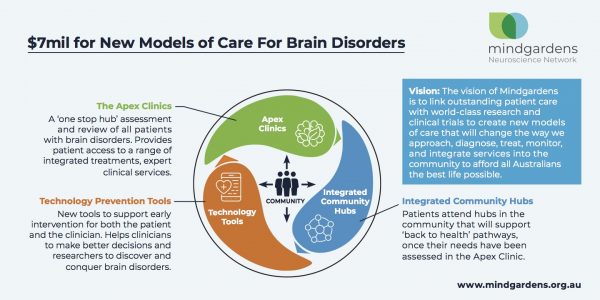
Pilot programs will include Apex Clinics, a
‘one-stop hub’ assessment and review of all patients with neurological,
mental health or addiction brain disorders; integrated community hubs,
providing customised and targeted community services offering the best
evidence-based care to patients and linked to general practice;
innovative data technologies to build prevention tools to support early
intervention for both the patient and the clinician.
Says Professor Helen Christensen AO,
Interim Co-CEO of Mindgardens: “our current models of care treat
individual disorders in a siloed manner. These disorders are frequently
coexisting, they share brain mechanisms and behavioural patterns. We
need to take a helicopter view that cuts across siloed service
provision, creating better and more comprehensive care”.
Mindgardens aims
to become the Australian Comprehensive Brain Disorder Centre for
clinical care, research and innovation where pilot programs like Apex
Clinics, Integrated Community Hubs and Preventative Technologies can be
developed and then rolled out nationally to support all Australians
living with a brain disorder.
Professor Peter Schofield AO, Interim
Co-CEO of Mindgardens says: “linking outstanding patient care with
world-class research is the way to mutually leverage research discovery
and treatment innovation.
This has been demonstrated in cancer care
where Comprehensive Cancer Centres have had great success in steering
research towards the clinical problems of patients and bringing the
benefits of research into patient care”.
“Our aim is to become an international
leading precinct for innovative research and compassionate healthcare
for all brain disorders,” says Professor Schofield.
Syncing brain waves may fight age-related memory problems
Would this help your stroke related memory problems? Ask your doctor and not politely. When will this become a working therapy?
Syncing brain waves may fight age-related memory problems
Published

"It's been called, classically, the 'workbench of the mind' or the 'sketchpad of the mind.' It allows us to hold information in our minds over a period of seconds," he continues.
Essentially, this is the type of memory that allows a person to make spontaneous calculations and assessments, and navigate daily life situations.
But working memory also starts to naturally decline with age, which means that, as a person grows older, they may find it more difficult to perform some tasks, such as keeping track of their finances.
"Working memory [...] is where we think, where we problem-solve, where we reason, plan, perform mathematical calculations, make decisions. It's essentially where consciousness lives."For this reason, Reinhart and colleagues have decided to look into why working memory begins to decline with age and to test experimental methods of reversing that decline.
Robert Reinhart, Ph.D.
"One of the major goals in the field of neurocognitive aging is to understand the brain basis for working memory decline in aging, and this is one of the goals that we tried to tackle in this [new] work," says Reinhart.
The researchers present their findings in a paper now published in the journal Nature Neuroscience.
The importance of brain wave synchronicity
The authors note that, so far, the working theory has been: This type of memory takes a hit later in life as a result of brain areas that would normally work together falling out of sync.A key characteristic of this desynchronization, they go on to explain, is the disruption of brain waves — patterns of electrical activity that indicate brain cell activity — that would normally coordinate. Scientists call this coordination "cross-frequency coupling."
More specifically, the researchers link the maintenance of working memory with the cross-frequency coupling of two types of brainwaves, gamma and theta, in the prefrontal and temporal regions of the brain.
Wednesday, April 24, 2019
People Hospital 115 achieves gold status in stroke treatment - Ho Chi Minh City
Big fucking whoopee.
I saw absolutely nothing about what should be done the first week or anything about measuring 30-day deaths and 100% recovery. Procedures and 60 minute treatment mean nothing if you don't measure results. I see nothing about measuring results so this means nothing.
People Hospital 115 achieves gold status in stroke treatment - Ho Chi Minh City
People
Hospital 115 in Ho Chi Minh City has become the first hospital in Asia
to achieve Gold status certification in treatment for stroke issued by
the European Stroke Organization.

The infirmary yesterday organized a meeting to receive the certification.
According to Professor Carlos Molina, head of the Vall d’Hebron
Hospital’s Stroke ward in Spain’s Barcelona, to achieve the level “ Gold
status”, the hospital ought to meet these criteria including
standardized stroke treatment procedure, quality and patients’ safety,
high rate of stroke patients treated within 60 minutes after being
admitted into the infirmary and scanned CT and MRI soon.
From 2017, the European Stroke Organization and the World Stroke
Organization have provided support to Vietnam in improving stroke
quality through Angels program nationwide by setting up high quality
stroke centers. With the support, the number of stroke centers in the
country has raised from 14 in 2017 to 73 now and all hospitals in the
country will have stroke medical units to save life of patients in the
near future.
People Hospital 115 Deputy Head Dr. Bui Minh Trang said that the
Cerebrovascular ward has treated nearly 12,000 stroke patients in 2018
with the rate of recovery of approximately 90 percent.
More importantly, the hospital has reduced the average length of
stay in hospital from 5.88 days in 2016 to 4.54 days in 2018. Reduction
of hospital stay length of stroke patients proved the hospital’s
effective treatment procedures.
Especially, the infirmary physicians have applied therapy with
clot-busting drugs (must start within 4.5 hours if they are given into
the vein — and the sooner, the better) and use a catheter to maneuver a
device into the blocked blood vessel in your brain and trap and remove
the clot ( This procedure is particularly beneficial for people with
large clots that can't be completely dissolved with tPA )
Presently, the hospital is preparing human resource for application
of a brain hemorrhage treatment that involves drilling a hole in the
skull to drain accumulated blood with the expectation to cut down on the
number of stroke deaths and disabilities due to stroke.
Chairman of Stroke Association in Ho Chi Minh City Dr. Nguyen Huy
Thang said at a lately seminar that just 19.4 percent of stroke patients
reach hospitals within 'golden hour' to get clot-busting drug;
accordingly, the number of stroke deaths are still high up to 18
percent.
Moreover, just 5.3 percent of stroke patients have been taken to
medical centers within 6 first hours while up to 75.3 percent come to
medical facilities after six first hours. Therefore, just 25 percent of
stroke patients receive timely treatment and they are highly likely
recover soon.
Worse, after treatment, just 5 percent of Vietnamese stroke
patient receive physical therapy while most of residents in developed
countries are taken to these special centers for physiotherapy.
An Investigation into the Clinical Use of Botulinum Toxin Type A to Treat Post-stroke Hemiplegic Patients with Upper and/or Lower Limb Spasticity
You had better hope your doctor does take into consideration your body size. There have been instances of children and small women who have died from botox.
An Investigation into the Clinical Use of Botulinum Toxin Type A to Treat Post-stroke Hemiplegic Patients with Upper and/or Lower Limb Spasticity
上下肢痙縮を有する脳卒中後の片麻痺患者を対象とした A 型ボツリヌス毒素製剤投与状況の調査. The Japanese Journal of Rehabilitation Medicine , Volume 52(7) , Pgs. 421-430.NARIC Accession Number: I244969. What's this?
Author(s): Akio KIMURA; Masahiro ABO; Yoshihisa MASAKADO; Yoshiyuki YAMASHITA; Toshio MAEDA.
Publication Year: 2015.
Abstract:
The purpose of this study was to investigate the clinical use of botulinum toxin type A (BoNT/A) by physicians with expertise in the treatment of upper and lower limb spasticity in post-stroke patients with spastic hemiplegia. To this end, a multicenter review was conducted of the medical records of 307 Japanese post-stroke patients treated with BoNT/A during the period January 1, 2012 to November 30, 2013. The review provided a variety of information on factors relating to BoNT/A injection outcomes, including the total dose of BoNT/A per treatment session, the dose of BoNT/A per muscle, the number of injection sites per muscle, the method used to locate the muscles to be injected, and the dilution of reconstituted BoNT/A. Review analysis indicated that the dose of BoNT/A administered per muscle was usually selected by taking into consideration the severity of spasticity, rather than the patient’s body size. Since the technical expertise of experienced clinicians is summarized in this review, it may serve as a useful reference for the use of BoNT/A in routine clinical practice.Descriptor Terms: Hemiplegia, Spasticity, Stroke.
Language: Japanese
Geographic Location(s): Japan, East & Southeast Asia.
Can this document be ordered through NARIC's document delivery service*?: Request Information.
Get this Document: https://www.jstage.jst.go.jp/article/jjrmc/52/7/52_421/_pdf/-char/en.
Citation: Akio KIMURA, Masahiro ABO, Yoshihisa MASAKADO, Yoshiyuki YAMASHITA, Toshio MAEDA. (2015). An Investigation into the Clinical Use of Botulinum Toxin Type A to Treat Post-stroke Hemiplegic Patients with Upper and/or Lower Limb Spasticity. 上下肢痙縮を有する脳卒中後の片麻痺患者を対象とした A 型ボツリヌス毒素製剤投与状況の調査. The Japanese Journal of Rehabilitation Medicine , 52(7), Pgs. 421-430. Retrieved 4/24/2019, from REHABDATA database.
This neuroscientist is using virtual reality to revolutionize stroke treatment
You mean all this earlier research wasn't enough to write up a protocol? I don't see a protocol here either, so useless. This has been known for years so not revolutionary. I would say this is actually incompetence since the research was out there already, this didn't need to be repeated.
- 3D virtual environments (1)
- virtual avatars (1)
- virtual environment (2)
- virtual reality (114)
- virtual reality games (7)
- virtual reality goggles (1)
- virtual reality training (13)
This neuroscientist is using virtual reality to revolutionize stroke treatment
Tej Tadi, founder of medical startup MindMaze, is gamifying rehabilitation for stroke survivors – and the results are inspiring
Tej Tadi
has always had one thing on his mind: the human brain. A
neuroscientist, engineer and entrepreneur, Tadi’s innovative approach to
stroke rehabilitation has earned him numerous accolades, including
being named one of Fast Company’s most creative people in business in
2018.
After years working in hospitals, Tadi realized traditional
treatments for stroke patients weren’t motivating or frequent enough to
maximize potential for a full recovery. So in 2012, he created MindMaze,
a neurorehabilitation company that uses virtual reality and
neuroscience to repair broken connections in the brain, and retrain the
body to move after a stroke. The technology has also been proven to
alleviate symptoms of phantom pain in amputees.
“I’ve seen so much suffering, and patients missing out on so many
things in life,” Tadi says. “With these technologies, I was able to
quickly see how something like virtual reality could truly make a
difference in a patient’s life.”
Because there’s such a short window after a stroke when the brain can bounce back, starting treatment early is critical. MindMotion Pro can be used in-hospital just four days after a brain injury, and studies found the training intensity of stroke patients using the device almost doubled in the first 10 sessions. Strokes are also devastating long-term, and Tadi found many patients had trouble motivating themselves once they were out of the hospital. With the portable MindMotion Go device, patients can start playing at home in just five minutes. Clinical research found patients motivated by the variety of goal-oriented games, and practiced up to 15 times more therapeutic exercises compared to traditional treatments.
By 2016, the start-up was valued at $1 billion, with the MindMaze VR
technology making its way into hospitals across Europe and Asia.
In-patient devices like MindMotion Pro, and portable devices like
MindMotion Go, have already helped more than 1,300 patients. Receiving
FDA approval in 2017, Tadi is preparing to launch MindMaze in the US,
where strokes are the fifth leading cause of death. Recently, MindMaze
also acquired Neuro Motor Innovations, a company that also utilizes game
therapy as a complementary treatment for stroke patients.
Tadi sees MindMaze as more of a passion project, one he hopes will revolutionize the way patients relearn to move and think, while motivating them to take recovery into their own hands.
“Human machine interfaces powered by brain technology are where the future is,” he says.
Because there’s such a short window after a stroke when the brain can bounce back, starting treatment early is critical. MindMotion Pro can be used in-hospital just four days after a brain injury, and studies found the training intensity of stroke patients using the device almost doubled in the first 10 sessions. Strokes are also devastating long-term, and Tadi found many patients had trouble motivating themselves once they were out of the hospital. With the portable MindMotion Go device, patients can start playing at home in just five minutes. Clinical research found patients motivated by the variety of goal-oriented games, and practiced up to 15 times more therapeutic exercises compared to traditional treatments.
MindMotion Pro is an in-hospital solution for early rehabilitation
Tadi sees MindMaze as more of a passion project, one he hopes will revolutionize the way patients relearn to move and think, while motivating them to take recovery into their own hands.
“Human machine interfaces powered by brain technology are where the future is,” he says.
A Mental Sign Of Vitamin B12 Deficiency - poor memory
Now is your doctor testing for this or just lazily using Occam's Razor to blame poor memory on stroke and do nothing about it? Ask your doctor that question, you need to know their competency.
A Mental Sign Of Vitamin B12 Deficiency - poor memory
Around one-quarter of people may be deficient in vitamin B12.
People in the study with low levels of vitamin B12 had worse memory for both ideas and events in their lives.
→ Support PsyBlog for just $4 per month. Enables access to articles marked (M) and removes ads.
Good sources of vitamin B12 include fish, poultry, eggs and low-fat milk.
Fortified breakfast cereals also contain vitamin B12.
People who may have difficulty getting enough vitamin B12 include vegetarians, older people and those with some digestive disorders, such as Crohn’s disease.
Dr Christine C. Tangney, the study’s first author, said:
“Our findings lend support for the contention that poor vitamin B12 status is a potential risk factor for brain atrophy and may contribute to cognitive impairment.”For the study, 121 older people were given tests of memory and thinking and had their vitamin B12 levels measured.
Brain scans 4.5 years later revealed brain shrinkage in those who were deficient.
B12 deficiency was also linked to worse scores on cognitive tests.
Dr Tangney said:
“Our findings definitely deserve further examination.Other, common signs of vitamin B12 deficiency include feeling tired, experiencing muscle weakness and being constipated.
It’s too early to say whether increasing vitamin B12 levels in older people through diet or supplements could prevent these problems, but it is an interesting question to explore.
Findings from a British trial with B vitamin supplementation are also supportive of these outcomes.”
About the author
 Psychologist, Jeremy Dean, PhD
is the founder and author of PsyBlog. He holds a doctorate in
psychology from University College London and two other advanced degrees
in psychology.
Psychologist, Jeremy Dean, PhD
is the founder and author of PsyBlog. He holds a doctorate in
psychology from University College London and two other advanced degrees
in psychology.He has been writing about scientific research on PsyBlog since 2004. He is also the author of the book “Making Habits, Breaking Habits” (Da Capo, 2003) and several ebooks:
Effects of a Whole Body Vibration as a Means for Controlling Spasticity in Post-stroke Patients: An F-wave Study
If this truly works as suggested it should be shouted to all stroke hospitals immediately. My leg spasticity is totally fucking up my gait and destroying my left knee. Your hospital will probably look at the words, 'further investigations' and do absolutely nothing with this. Your stroke hospital president, board of directors and stroke department head all need to be fired for such a lame response to this research.
Effects of a Whole Body Vibration as a Means for Controlling Spasticity in Post-stroke Patients: An F-wave Study
脳卒中片麻痺下肢へ の 全 身振動刺激 (Whole body vibration ) に よ る痙 縮抑制効果 * 誘 発 電 位 F 波 を用 い た 検 討. Physical Therapy Japan , Volume 42(2) , Pgs. 90-97.NARIC Accession Number: I244943. What's this?
Author(s): Kodai MIYARA; TomohiroUEMA; Takuya HIROKAWA; Tomokazu NOMA; Keiko IKEDA; Shuji MATSUMOTO; Megumi SHIMODOZONO; KAZUMI KAWAHIRA.
Publication Year: 2015.
Abstract:
The objective of this study was to investigate the mechanism of spasticity suppression using whole body vibration (WBV) in post-stroke patients with lower-limb hemiplegia. F-wave was used to evaluate the excitability of anterior horn cells in the spinal cord. Participants were 10 post-stroke patients with a mean age of 49.3 ± 13.0 years and lower-limb spasticity. Each patient sat on a chair with hip joint angles at 90˚ of flexion and knee joint angles at 0˚ of extension. WBV was applied at 30 Hz (4-8 mm amplitude) for 5 min on the hamstring and triceps surae muscles. The Modified Ashworth Scale (MAS) as a measure of spasticity, the F-wave parameters (F-wave amplitude, F/M ratio), the active and passive range of motion (A-ROM, P-ROM), and the 10-m walk test as a measure of walking ability were evaluated before and after the WBV intervention. The MAS score, the A-ROM for ankle dorsiflexion, P-ROM, and walking ability were found to be significantly improved. In addition, the F-wave amplitude showed a tendency to decrease, and the F/M ratio significantly decreased. These results showed reduction of F-wave amplitude and F/M ratio after the WBV intervention, with a corresponding decrease in the MAS score. Suppression of the anterior horn cells by WBV might have led to the suppression of spasticity in this study. Further investigations are deemed necessary to confirm the applicability of the WBV for the treatment of spasticity in post-stroke patients.Descriptor Terms: Hemiplegia, Lower extremities, Muscles, Spasticity, Stroke, Therapy, Spinal cord.
Language: Japanese
Geographic Location(s): Japan, East & Southeast Asia.
Can this document be ordered through NARIC's document delivery service*?: Request Information.
Get this Document: https://www.jstage.jst.go.jp/article/rigaku/42/2/42_KJ00009930364/_pdf/-char/en.
Citation: Kodai MIYARA, TomohiroUEMA, Takuya HIROKAWA, Tomokazu NOMA, Keiko IKEDA, Shuji MATSUMOTO, Megumi SHIMODOZONO, KAZUMI KAWAHIRA. (2015). Effects of a Whole Body Vibration as a Means for Controlling Spasticity in Post-stroke Patients: An F-wave Study. 脳卒中片麻痺下肢へ の 全 身振動刺激 (Whole body vibration ) に よ る痙 縮抑制効果 * 誘 発 電 位 F 波 を用 い た 検 討. Physical Therapy Japan , 42(2), Pgs. 90-97. Retrieved 4/24/2019, from REHABDATA databas
Cardiopulmonary responses during clinical and laboratory gait assessments in people with chronic stroke
I got nothing out of this that could help survivors recover. My cardiopulmonary responses would have been excellent, I was in that good of shape. I don't believe that I ever did the six minute walk test. My therapists never pushed me hard enough to increase my heart rate, they were afraid.
Cardiopulmonary responses during clinical and laboratory gait assessments in people with chronic stroke
Physical Therapy , Volume 99(1) , Pgs. 86-97.NARIC Accession Number: J80630. What's this?
ISSN: 0031-9023.
Author(s): Woodward, Jane L.; Connolly, Mark; Hennessy, Patrick W.; Holleran, Carey L.; Mahtani, Gordhan B.; Brazg, Gabrielle; Fahey, Meghan; Maganti, Kameswari; Hornby, T. George.
Project Number: H133B031127.
Publication Year: 2019.
Number of Pages: 12.
Abstract:
Study examined cardiorespiratory responses during assessments of walking function, including the 6-Minute Walk Test (6MWT) and graded exercise tests (GXTs), and evaluated their associations with demographic or clinical characteristics in individuals with chronic stroke. Cardiorespiratory responses and heart rate (HR) measures were collected during 6MWTs at self-selected velocity and fastest velocity (FV), and during GXTs. Specific metabolic measures include the rate of oxygen consumption (VO2) and the respiratory exchange ratio. Secondary assessments included the lower-extremity Fugl-Meyer Assessment, Functional Gait Assessment, gait speeds, and daily stepping activity. Correlation and regression analyses were used to evaluate associations between locomotor performance, cardiorespiratory responses, and clinical and demographic characteristics. Average HRs during 6MWT-FV were 72 to 76 percent of the age-predicted maximum (HRmax), with 20 percent of participants exceeding 85 percent of predicted HRmax. When normalized to HRs during GXTs, HRs during 6MWT-FV were 86 to 88 percent of observed HRmax. Primary predictors of increased HRs during 6MWTs were resting HR, body mass index, and daily stepping. Distance during 6MWT-FV was a significant predictor of VO2peak in combination with other variables. Electrocardiographic abnormalities were observed in >80 percent of participants at rest and 31 percent demonstrated distinct abnormalities during GXTs, which were not related to 6MWT or GXT performance. Results indicated that cardiac responses were higher than anticipated during 6MWTs and often exceeded recommended HR thresholds. These findings suggest that clinicians should closely monitor cardiorespiratory responses during 6MWTs.Descriptor Terms: AMBULATION, CARDIOPULMONARY FUNCTION, CARDIOVASCULAR FUNCTION, CLIENT CHARACTERISTICS, DEMOGRAPHICS, EXERCISE, MEDICAL ASPECTS, MOTOR SKILLS, PHYSICAL THERAPY, STROKE.
Can this document be ordered through NARIC's document delivery service*?: Y.
Citation: Woodward, Jane L., Connolly, Mark, Hennessy, Patrick W., Holleran, Carey L., Mahtani, Gordhan B., Brazg, Gabrielle, Fahey, Meghan, Maganti, Kameswari, Hornby, T. George. (2019). Cardiopulmonary responses during clinical and laboratory gait assessments in people with chronic stroke. Physical Therapy , 99(1), Pgs. 86-97. Retrieved 4/24/2019, from REHABDATA database.
Factors associated with 1-year mortality after discharge for acute stroke: What matters?
Well, if you don't even measure the size and location of the dead and damaged areas in the brain you have not even done any correct analysis of why these people died. All your measurement points are useless for that determination. Your mentors and senior researchers need to be fired and banned from stroke research.
Factors associated with 1-year mortality after discharge for acute stroke: What matters?
Topics in Stroke Rehabilitation , Volume 25(8) , Pgs. 576-583.NARIC Accession Number: J80603. What's this?
ISSN: 1074-9357.
Author(s): Magdon-Ismail, Zainab; Ledneva, Tatiana; Sun, Mingzeng; Schwamm, Lee H.; Sherman, Barry'Qian, Feng; Bettger, Janet P.; Xian, Ying; Stein, Joel.
Publication Year: 2018.
Number of Pages: 8.
Abstract:
Study evaluated factors associated with 1-year mortality after discharge for acute stroke. Data were analyzed for 305 patients with ischemic stroke or intracerebral hemorrhage discharged from stroke rehabilitation in 2010/2011. Patient demographics, stroke severity, prestroke functional status, functional status on admission and at discharge, stroke type, comorbidities, socioeconomic status, social support, in-hospital length of stay, and discharge destination were examined. Multivariate regression models were used to examine variables related to 1-year all-cause poststroke mortality. The mean age was 68.6 years and 51.1 percent were women. A total of 146 (47.9 percent) were discharged directly home, 96 (31.5 percent) to inpatient rehabilitation facilities, and 63 (20.7 percent) to skilled nursing facilities. Overall, 24 (7.9 percent) patients died within 1-year post-discharge. Older age, higher National Institutes of Health Stroke Scale (NIHSS) score on admission, and discharge destination were factors associated with 1-year all-cause mortality. When ambulation status at discharge was added to the model, ambulation with assistance and non-ambulation were significantly associated with mortality. While age and NIHSS on admission are important predictors of long-term outcomes, factors at discharge – ambulation status at discharge and discharge destination – are associated with 1-year mortality post-discharge for acute stroke and therefore could represent therapeutic targets to improve long-term survival in future studies.Descriptor Terms: CLIENT CHARACTERISTICS, DEATH, DEMOGRAPHICS, MEDICAL ASPECTS, OUTCOMES, REHABILITATION, STROKE.
Can this document be ordered through NARIC's document delivery service*?: Y.
Citation: Magdon-Ismail, Zainab, Ledneva, Tatiana, Sun, Mingzeng, Schwamm, Lee H., Sherman, Barry'Qian, Feng, Bettger, Janet P., Xian, Ying, Stein, Joel. (2018). Factors associated with 1-year mortality after discharge for acute stroke: What matters?. Topics in Stroke Rehabilitation , 25(8), Pgs. 576-583. Retrieved 4/24/2019, from REHABDATA database.
High-intensity respiratory muscle training improves strength and dyspnea poststroke: A double-blind randomized trial
So it works but is useless because no protocol was created and distributed worldwide. The mentors and senior researchers associated with this should be fired. The whole fucking point of stroke rehab research is to deliver protocols. This failed at that. Because of this failure you, your doctors and therapists will have to guess what the hell high-intensity respiratory muscle training is and what the objective starting point is. Good luck with that. Journal editors shouldn't even allow crapola like this to be published. A great stroke association president would ensure journals follow stroke research publishing standards.
High-intensity respiratory muscle training improves strength and dyspnea poststroke: A double-blind randomized trial
Archives of Physical Medicine and Rehabilitation , Volume 100(2) , Pgs. 205-212.NARIC Accession Number: J80503. What's this?
ISSN: 0003-9993.
Author(s): Menezes, Kenia K. P.; Nascimento, Lucas R.; Ada, Louise; Avelino, Patrick R.; Polese, Janaine C.; Alvarenga, Maria T. M.; Barbosa, Mariana H.; Texeira-Salmela, Luci F..
Publication Year: 2019.
Number of Pages: 8.
Abstract:
Study examined whether high-intensity, home-based respiratory muscle training would increase the strength and endurance of the respiratory muscles, reduce dyspnea and respiratory complications, and improve walking capacity post-stroke. Thirty-eight patients with stroke, who had respiratory muscle weakness, were randomized to the experimental or control group. The experimental group received 40-minute high-intensity home-based respiratory muscle training (that is, with higher loads, delivered more frequently and for longer duration, than previously applied) 7 days per week, for 8 weeks, progressed weekly. The control group received a sham intervention of similar dose. The primary outcome was inspiratory muscle strength (via maximal inspiratory pressure); secondary outcomes were expiratory muscle strength (maximal expiratory pressure), inspiratory muscle endurance, dyspnea (Medical Research Council score), respiratory complications (hospitalizations), and walking capacity (6-Minute Walk Test). Outcomes were measured at baseline, after intervention, and 1 month beyond intervention. Compared to the control group, the experimental group increased inspiratory and expiratory strength, inspiratory endurance, and reduced dyspnea, and the benefits were maintained at 1 month beyond training. There was no significant between-group difference for walking capacity or respiratory complications. Results demonstrate that high-intensity home-based respiratory muscle training was effective in increasing strength and endurance of the respiratory muscles and reducing dyspnea for people with respiratory muscle weakness post stroke. The magnitude of the effect was higher, than that previously reported in studies, which applied standard protocols.Descriptor Terms: EXERCISE, MUSCLES, RESPIRATORY DISEASE, STROKE, THERAPEUTIC TRAINING.
Can this document be ordered through NARIC's document delivery service*?: Not available from NARIC.
Citation: Menezes, Kenia K. P., Nascimento, Lucas R., Ada, Louise, Avelino, Patrick R., Polese, Janaine C., Alvarenga, Maria T. M., Barbosa, Mariana H., Texeira-Salmela, Luci F.. (2019). High-intensity respiratory muscle training improves strength and dyspnea poststroke: A double-blind randomized trial. Archives of Physical Medicine and Rehabilitation , 100(2), Pgs. 205-212. Retrieved 4/24/2019, from REHABDATA database.
Subscribe to:
Posts (Atom)