Use the labels in the right column to find what you want. Or you can go thru them one by one, there are only 34,483 posts. Searching is done in the search box in upper left corner. I blog on anything to do with stroke. DO NOT DO ANYTHING SUGGESTED HERE AS I AM NOT MEDICALLY TRAINED, YOUR DOCTOR IS, LISTEN TO THEM. BUT I BET THEY DON'T KNOW HOW TO GET YOU 100% RECOVERED. I DON'T EITHER BUT HAVE PLENTY OF QUESTIONS FOR YOUR DOCTOR TO ANSWER.
Changing stroke rehab and research worldwide now.Time is Brain!trillions and trillions of neuronsthatDIEeach day because there areNOeffective hyperacute therapies besides tPA(only 12% effective). I have 523 posts on hyperacute therapy, enough for researchers to spend decades proving them out. These are my personal ideas and blog on stroke rehabilitation and stroke research. Do not attempt any of these without checking with your medical provider. Unless you join me in agitating, when you need these therapies they won't be there. Did your doctor somehow miss the recovery protocol that Pedro Bach-y-Rita used to recover fully back in 1958 with only a partial brain?
What this blog is for:
My blog is not to help survivors recover, it is to have the 10 million yearly stroke survivors light fires underneath their doctors, stroke hospitals and stroke researchers to get stroke solved. 100% recovery. The stroke medical world is completely failing at that goal, they don't even have it as a goal. Shortly after getting out of the hospital and getting NO information on the process or protocols of stroke rehabilitation and recovery I started searching on the internet and found that no other survivor received useful information. This is an attempt to cover all stroke rehabilitation information that should be readily available to survivors so they can talk with informed knowledge to their medical staff. It lays out what needs to be done to get stroke survivors closer to 100% recovery. It's quite disgusting that this information is not available from every stroke association and doctors group.
We’re sharing this article early to provide faster access to peer-reviewed, accepted research. It is citable and carries a permanent DOI. This version is subject to further edits and will be replaced automatically by the final Version of Record. All legal disclaimers apply.
Abstract
Background
Stroke is a leading cause of long-term adult disability, with approximately 80% of survivors experiencing upper extremity (UE) motor impairments. Clinical assessment tools like the Fugl-Meyer Assessment (FMA) are widely used but limited by ordinal scales and subjective observation. While rehabilitation robots offer high-resolution data, their clinical translation is hindered by a lack of standardized protocols and limited interpretability for clinical decision-making.
Objective
This study aimed to develop an objective, standardized, and clinically interpretable assessment tool to quantify UE motor qualities by integrating exoskeleton technology with traditional clinical assessment tasks.
Methods
Ten healthy individuals and ten stroke survivors performed seven standardized tasks (six from the FMA-UE and one additional elbow task) while wearing the HARMONY exoskeleton. We developed a “trajectory pattern discrepancy score” based on the root mean square error between individual joint trajectories and normative averages. Additionally, kinematic synergy analysis was performed using non-negative matrix factorization to evaluate alterations in multi-joint coordination.
Results
The trajectory pattern discrepancy score showed a strong negative correlation with clinical FMA-UE scores (r = -0.93, p < 0.01) and demonstrated excellent test-retest reliability (ICC = 0.98). The number of identified kinematic synergies decreased significantly as motor impairment severity increased (r = 0.79, p < 0.01). Furthermore, kinematic synergy analysis provided a mechanistic explanation for reduced individual joint control. Post-stroke synergies could be explained through the merging (linear combinations of healthy kinematic patterns), preservation, or loss of healthy kinematic synergies, reflected as pathological joint coupling and loss of specific individual joint control.
Conclusions
This study presents a novel, standardized assessment framework that integrates exoskeleton technology with conventional clinical tasks. By bridging the gap between objective robotic data and clinical interpretability, this approach would enable robust motor impairment assessment and intuitive phenotyping of motor characteristics to guide personalized rehabilitation strategies.
Two University of Texas at Arlington undergraduates have won a national invention award for developing a lightweight, wearable soft robotic wrist exoskeleton designed to help stroke survivors regain wrist function.
Suyog Neupane, a senior majoring in electrical engineering, and Kritazya Upreti, a senior majoring in computer science, earned first place in the university-level division of the 2026 National Academy of Inventors GenSpiration Prize Competition in Los Angeles. The competition brought together student inventors from universities across the United States, and UTA was one of only three finalist teams.
The students were inspired by the global impact of stroke, which affects millions of people each year. Loss of wrist and hand function is one of the most common consequences of stroke, making everyday activities such as eating, writing and turning a doorknob difficult or impossible.
"Competing against such talented innovators was both an incredible honor and an inspiring experience," Upreti said. "Seeing our hard work and innovation recognized on such a large stage was truly rewarding."
Their invention is a soft pneumatic wrist exoskeleton powered by air pressure rather than heavy motors or rigid mechanical components. Its key innovation is that it can produce two degrees of wrist motion simultaneously—flexion/extension and radial/ulnar—using a single compact soft actuator, improving portability while reducing mechanical complexity.
"Most devices currently available for wrist rehabilitation are either too heavy, bulky or difficult to operate," Upreti said. "One of our main motivations was to develop a solution that could provide multiple wrist motions using a single actuator."
From left to right: Suyog Neupane, Kritazya Upreti and Inderjeet Singh pose with their invention. (UT Arlington)
The undergraduate team was mentored by Inderjeet Singh, a research scientist at the University of Texas at Arlington Research Institute. He emphasized that the design is grounded in modern rehabilitation robotics principles, where effective recovery depends on providing controlled, repeatable and task-specific movement training. He added that supporting multiple wrist movements together is critical because natural hand function depends on them working in coordination, making that capability essential for meaningful rehabilitation.
The exoskeleton is designed to support patients throughout different stages of stroke recovery. For individuals with severe motor impairments, it can assist with the repetitive wrist movements commonly prescribed during rehabilitation. As patients regain strength and mobility, the device transitionts to assisting voluntary wrist movements, enabling users to perform therapeutic exercises and promoting active participation in the recovery process.
Related: Do more with less strain: UTA’s robotic arm
The award-winning project was the result of a collaborative effort within the Biomedical Technologies Lab at UTARI. Along with mentoring the student inventors, Dr. Singh and UTARI research scientist Veysel Erel led the project's research and development. UTARI research scientists Allison Palomino and Sahil Mangaonkar contributed to device fabrication and electronics development, while UTARI research scientist Alex Jamieson provided valuable support in refining and finalizing the overall system. Together, the multidisciplinary team transformed an innovative concept into a nationally recognized technology.
The exoskeleton can be used to help with many tasks. (UT Arlington)
Beyond stroke rehabilitation, the researchers see broader applications for the device. Individuals whose occupations involve repetitive wrist movements—such as assembly-line workers and heavy-equipment operators—could potentially use the exoskeleton to reduce fatigue, minimize strain, and lower the risk of work-related musculoskeletal injuries.
"What means the most to us is the potential for our technology to make a positive impact on the lives of stroke survivors," Neupane said. "The journey was both challenging and exciting, filled with moments of trial and error that pushed us to think more creatively and innovate."
About The University of Texas at Arlington (UTA)
The University of Texas at Arlington is a growing public research university in the heart of Dallas-Fort Worth. With a student body of over 42,700, UTA is the second-largest institution in the University of Texas System, offering more than 180 undergraduate and graduate degree programs. Recognized as a Carnegie R-1 university, UTA stands among the nation’s top 5% of institutions for research activity. UTA and its 300,000 alumni generate an annual economic impact of $28.8 billion for the state. The University has received the Innovation and Economic Prosperity designation from the Association of Public and Land Grant Universities and has earned recognition for its focus on student access and success, considered key drivers to economic growth and social progress for North Texas and beyond.
The NeuroLife company closes $2.9 million seed round with founding partners Battelle and The NeuroTech Institute to advance wearable neurotechnology toward clinical validation
NeuroLife® Launch Brings Non-Invasive Technology Aimed at Restoring Hand and Arm Movement After Stroke and Spinal Cord Injury
COLUMBUS, Ohio--(BUSINESS WIRE)--NeuroLife today launched as a non-invasive neurotechnology company developing wearable solutions to support rehabilitation for people affected by stroke or spinal cord injury. NeuroLife is the market-facing brand of ActivateNeuro, Inc. and is established through a strategic partnership between Battelle and The NeuroTech Institute (NTI).
"Our goal is to develop a non-invasive platform that supports functional hand and arm use by making therapy more personalized, responsive and aligned with how the body naturally moves," said Jon Snyder, CEO of NeuroLife.
In the United States, stroke and spinal cord injury affect millions of people, including approximately 7.8 million stroke survivors, representing a significant and growing global rehabilitation market (Centers for Disease Control and Prevention). Despite significant need, access to personalized, high-intensity therapy remains limited for many patients.
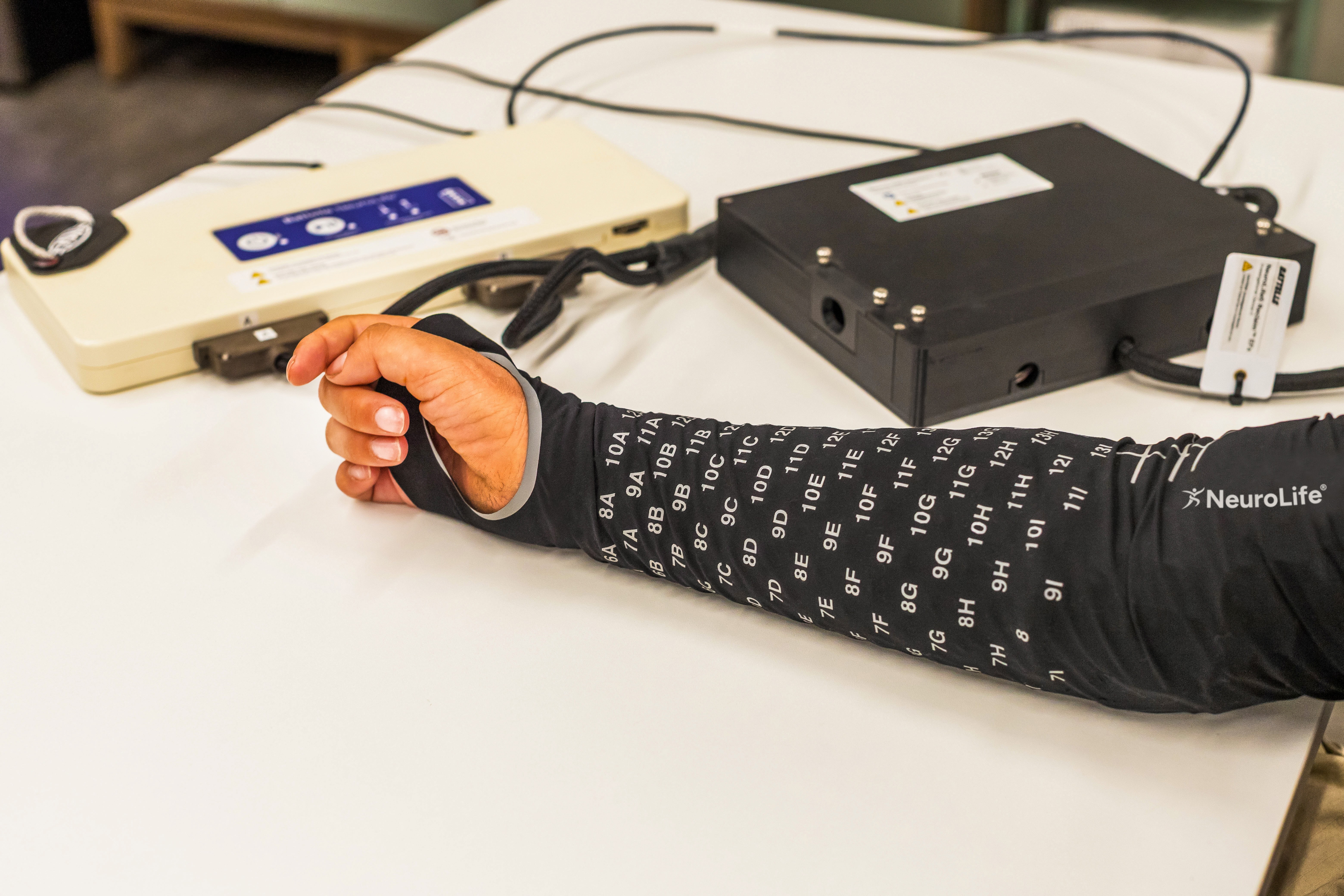
NeuroLife technology addresses this gap with a wearable sleeve that reads electrical signals from muscles and nerves, interprets movement intent and delivers targeted stimulation to support functional hand and arm recovery during guided therapy. The platform integrates high-density neuromuscular sensing, intelligent decoding and adaptive stimulation translating neuromuscular signals into real-time feedback to support personalized, signal-driven rehabilitation.
"NeuroLife represents a focused step forward in how rehabilitation can evolve," said Jon Snyder, CEO of NeuroLife. "Our goal is to develop a non-invasive platform that supports functional hand and arm use by making therapy more personalized, responsive and aligned with how the body naturally moves."
"Battelle has a long history of translating scientific innovation into real-world impact," said Matt McFarland, Vice President of Commercial Strategy at Battelle. "Our collaboration with NTI and the formation of NeuroLife advances neurotechnology from foundational research into clinical and commercial development. NeuroLife brings the rigor of Battelle's research capabilities into a platform built for clinical environments and patient impact."
Built as a flexible system, the platform is designed to support applications across rehabilitation, neuromuscular analytics and future neuro-enabled solutions. Its wearable, non-invasive design is intended to support accessibility, ease of use and integration into clinical workflows.
NeuroLife has completed a $2.9 million seed round with founding partners Battelle and NTI providing foundational capital, including licensing of Battelle’s NeuroLife platform technology. The company is pursuing FDA clearance for its wearable platform and has established a development roadmap focused on clinical validation, regulatory progression and commercial scalability.
NeuroLife is actively engaging partners across medtech, digital health and clinical research to accelerate development. Organizations interested in co-development opportunities, clinical pilot programs or strategic investment are encouraged to contact the company directly.
About NeuroLife
NeuroLife is the market-facing brand of ActivateNeuro, Inc., formed through a strategic partnership between Battelle and The NeuroTech Institute (NTI). The company is advancing non-invasive neurotechnology to support personalized, data-driven rehabilitation for people recovering from stroke or spinal cord injury. NeuroLife® technology is designed to support applications across rehabilitation, neuromuscular analytics and future neuro-enabled solutions. Learn more at www.neurolifetech.com.
About Battelle
Every day, the people of Battelle apply science and technology to solving what matters most. At major technology centers and national laboratories around the world, Battelle conducts research and development, designs and manufactures products, and delivers critical services for government and commercial customers. Headquartered in Columbus, Ohio since its founding in 1929, Battelle serves the national security, health and life sciences, and energy and environmental industries. For more information, visit www.battelle.org.
About The NeuroTech Institute
The NeuroTech Institute (NTI) was launched in October 2022 in partnership with The Ohio State University, a leading academic medical center, to advance neurological research and treatments for patients with neurological disorders. www.neurotechinstitute.org.
A “smart underwear” device, created by scientists at University of Maryland (UMD) in College Park, Maryland, monitors frequency of flatulence and hydrogen concentration in hopes of more accurately setting a baseline for what’s typical.
The device is about the size of three stacked nickels that can be snapped onto the exterior of any underwear near the perineal region. It uses electrochemical sensors and researchers receive the readings through an app around the clock.
It’s the “first wearable for monitoring gut microbiome activity via flatus hydrogen,” according to the researchers, led by first author Santiago Botasini, PhD, a UMD assistant research scientist with the Department of Cell Biology and Molecular Genetics. The team introduced the device in a study published in Biosensors and Bioelectronics: X.
Previous Tracking Methods Limited
Few flatulence studies have been conducted and much of the research had been done using rectal tubes, Brantley Hall, PhD, Department of Cell Biology and Molecular Genetics, UMD, told Medscape Medical News, “but rectal tubes aren’t a very comfortable, scalable approach. We think there’s an opportunity to build on that so we can understand flatulence patterns. You can ask people how much they fart, but it’s not very accurate. People’s perception is really off. Clinicians need better evidence.”
Asking people about frequency also misses accounting for the time a person is asleep, something the underwear device can automatically capture, he noted.
In a weeklong User Experience Study, participants who were asked to wear the device for at least 3 days reported high comfort and compliance. In a second study, the device accurately detected increased hydrogen production after inulin ingestion with 94.7% sensitivity in 38 healthy participants, demonstrating its ability to track changes in microbial metabolism with diet changes.
Individual Variation Extreme
The research also found that healthy adults expel gas about 32 times a day, about twice as often as the current literature states. Individual variation was extreme, researchers found.
Recently, one person’s device logged expulsions “more than 300 times a day,” Hall said. “We’ve shipped out about 100 devices so far and we’re starting to get some interesting results.” And though 300 was the highest number so far, some devices are showing 200-plus readings, he said.
“If clinicians learned in their medical textbook that 14 +/- 6 flatus a day is normal and someone says, ‘I’m farting 200 times a day’, that can cause anxiety for patients,” Hall said. “Flatus is the most noticeable thing your microbiome does,” he said. “And it’s insane to me that we’re not measuring it. For us to identify what’s abnormal, we first have to find out what’s normal.”Toward that end, Hall’s Lab launched the Human Flatus Atlas. The project will use smart underwear to track flatulence patterns and correlate those patterns with diet and microbiome composition for a diverse population. Devices are shipped to participants in the US.
Not a Medical Device
The tracker is not a medical device, Hall emphasized, “but I think it could help clinicians inform the directions of their treatment.”
“We hope to capture a baseline that is a trustworthy, scientifically validated number of flatus,” he said. “It will give a pretty unprecedented view of something that’s been invisible until now.”
He said he thought originally it might be hard to recruit people to sign up to use the device, but that wasn’t the case. “We’re completely overwhelmed with the demand” and currently offering only a waitlist. “We’ve made 850 devices and we’ve had more than 5000 people sign up to be part of the research,” Hall said.
Supriya Rao, MD, managing partner of Integrated Gastroenterology Consultants in Boston, said this work fills a gap.
“Until now we have relied on breath tests, invasive rectal tube studies, and symptom reporting which are really, limited snapshots,” she told Medscape Medical News. “This device can capture real time data over days and shows that people pass gas more frequently than we previously thought. It challenges some of our baseline assumptions about that normal physiology.”
Timing and Pattern Important
She said timing and pattern matter just as much as magnitude in medicine. “We care about whether fermentation occurs and when it begins, how frequent it is, and how it evolves throughout the day. Do we see hydrogen production increase after a meal, or is there a delay? Timing can tell us a lot,” she explained.
Gastroenterologists often see a disconnect between a patient’s perception of bloating and the actual volume of gas present. “This could help me figure out whether a patient’s symptoms are coming from excess gas production or from heightened sensitivity in the gut. This would allow us to tailor treatments more effectively,” she said.
She noted that the studies were small and done in healthy volunteers and characterized the device as “promising.”
“I would like to see a study done with those with gastrointestinal disorders. Hydrogen is only one part of the metabolic puzzle in our guts. Some microbes consume hydrogen and not all fermentation pathways produce it,” she noted.
Botasini reported having a relationship with Ventoscity LLC that included equity or stocks. Hall reported having a relationship with Ventoscity LLC that included board membership and equity or stocks. Botasini and Hall reported having a patent pending on Smart Underwear to Measure Volatile Metabolites Produced by the Human Gut Microbiota to Licensee from the UMD by Ventoscity LLC. Botasini and Hall reported having a patent on Method for Assessing the Likelihood of Malabsorption or SIBO via Measurements of Gut Microbial Gas Production Excreted in Flatus pending to Licensee from the UMD by Ventoscity LLC. Hall and Botasini reported having submitted two patent applications about the uses for the Smart Underwear device and cofounded a startup, Ventoscity LLC, to commercialize the technology and Ventoscity LLC has licensed the patents from the UMD. The other authors had no other conflicts to declare.
This work was supported by UMD Startup funds to Hall, the Maryland Technology Development Corporation through the Maryland Innovation Initiative, and the UM Ventures Medical Device Development Fund.
Rao reported having no relevant financial relationships.
Finally, your competent? doctor can get an objective diagnosis of gait problems AND DELIVER EXACT REHAB PROTOCOLS! Oh, too bad your doctor has no protocols at all for your recovery! JUST USELESS GUIDELINES! And doesn't even know how fucking useless they are! Guidelines don't guarantee recovery, why doesn't your incompetent? doctor know that?
Stephen Johna and Kolapo S. Allib,Ψ
Faculty of Engineering, The University of the West Indies, Mona Campus, Kingston 7, Jamaica, West Indies
a Email: preachdword3@yahoo.com
b Email: kolapo.alli@uwimona.edu.jm
Ψ Corresponding Author
(Received 27 December 2024; Revised 28 August 2025; Accepted 05 September 2025)
Abstract:
This paper presents the findings of a study on real-time gait monitoring and wearable suit for post stroke
rehabilitation of disabled persons. The study measured irregularities in their hips, lower back, feet, knees and ankles,
non-invasively, as well as the walking speed. A prototype was developed with eight gait sensor circuits which are
attached to a full body suit via suitable Velcro straps and placed at various regions of the body including the hip, lower
back, feet, knees and ankles. Each circuit consists of an ESP8266 module programmed with an Arduino code. This allows
the MPU6050 sensor within the circuit to measure both acceleration and angular velocity in three planes: x, y and z for
each targeted region of the body and display them on waveform charts via a LabView graphical user interface. This is
achieved by sending the data wirelessly from the sensor circuit to a suitable LabView VI on a computer via Transmission
Control Protocol (TCP). Statistical evaluations of motion analysis on clinical trials were performed to know the
effectiveness of the proposed system. The comparisons from the walking gait patterns results show that the standard
deviations obtained for the angular accelerations in x, y and z planes ranged from 2.896 to 9.497 rad/s2, 1.856 to 6.6312
rad/s2 and 2.951 to 10.209 rad/s2, respectively, with the mean values ranged from 2.089 to 9.453 rad/s2, 1.519 to 7.556
rad/s2 and 1.276 to 5.938 rad/s2, respectively. The standard deviations were closed for the angular velocities in x, y and
z planes ranged from 0.7231 to 1.9443 rad/s, 0.5509 to 1.527 rad/s and 0.3676 to 1.1791 rad/s with the mean values
ranged from 0.2763 to 0.833 rad/s, 1.1849 to 2.6565 rad/s and 0.777 to 2.235 rad/s, respectively. The LabVIEW platform
can offer diverse visualisation features for gait analysis. This study demonstrates the use of the platform to aid monitor
patients with walking disabilities.
Keywords: Gait sensors, stroke rehabilitation, LabView TCP server vi, Clinical trials, gait speed and acceleration