Wrong question! Can AI deliver a guaranteed recovery? Doesn't anyone in stroke know that 100% recovery is the only goal in stroke? You can't let your stroke medical 'professionals' decide what is your recovery endpoint. They work for you. If they are incompetent at their job, GET THEM FIRED!
BeAble Health’s Habib Ali discusses how AI and gamified therapy can improve patient engagement, personalise rehabilitation and support functional recovery
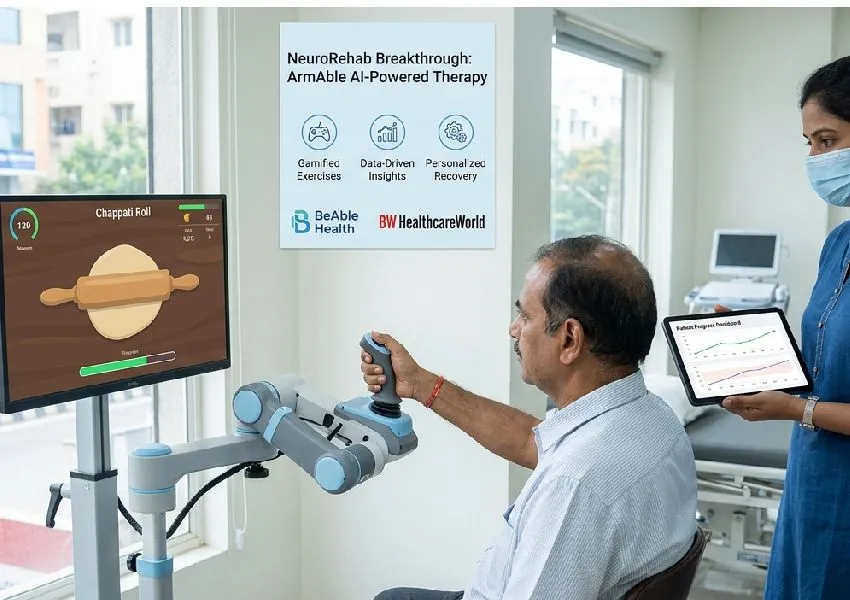
Stroke remains a leading cause of death and long-term disability worldwide. According to the World Stroke Organization’s Global Stroke Fact Sheet 2025, 11.9 million people experienced a new stroke in 2021, while more than 93 million were living with its consequences. The report identifies rehabilitation as a critical part of recovery, although access to multidisciplinary services remains limited, particularly in low- and middle-income countries. India faces a significant rehabilitation gap. A WHO Systematic Assessment of Rehabilitation Situation (STARS) review reported that the country has around 1,000 physiatrists and only 150 designated rehabilitation facilities. Nearly 40per cent of stroke survivors experience moderate-to-severe disability, while about 50per cent develop spasticity. Data from the Longitudinal Ageing Study in India also found that although stroke prevalence among adults aged 45 and above was 1.8per cent, only around 40per cent of survivors had accessed physiotherapy or occupational therapy.Technology-assisted rehabilitation could help address some of these challenges. A systematic review and meta-analysis of 42 trials involving 1,760 participants found that serious-game interventions led to significantly greater improvements in upper-limb motor function than conventional therapy, with a standardised mean difference of 0.47. However, researchers noted that the quality and certainty of evidence varied, underscoring the need for larger, well-designed clinical trials. Against this backdrop, BeAble Health has developed ArmAble, a game-based, AI-enabled rehabilitation device that turns repetitive exercises into familiar activities such as dosa making, chapati rolling and mosquito swatting. Designed for stroke survivors, spinal cord injury patients and people with neurological conditions, the device aims to improve engagement while enabling physiotherapists to track movement, personalise therapy and assess progress. In an exclusive conversation with BW HealthcareWorld, Habib Ali, CEO and Co-founder, BeAble Health, discusses how ArmAble is making neurological rehabilitation more engaging, personalised and data-driven while supporting physiotherapists in monitoring progress and functional recovery.Here are the excerpts from the conversation: How does BeAble’s ArmAble make rehabilitation more engaging and patient-driven, and what impact has it had on motivation and recovery?(Motivation is incredibly easy to solve! EXACT 100% RECOVERY PROTOCOLS! Your patient will gladly do the millions of reps needed because they are looking forward to recovery! Can't see that? YOU'RE FIRED!) One of the biggest challenges in rehabilitation is keeping patients motivated over weeks and months of repetitive therapy. Our device ‘ArmAble’ addresses this by converting conventional exercises into relatable game-based activities that closely resemble everyday tasks. For example, we have activities such as making dosas, rolling chapatis, swatting mosquitoes, balloon pop, table tennis, etc. These games are not designed purely for engagement. Every movement is linked to a rehabilitation goal such as improving movement, coordination and muscle control. Since these activities closely resemble movements patients perform in their daily lives, the skills developed during therapy are more likely to translate into functional independence. Rather than practising isolated movements, patients are rehearsing tasks they hope to return to after recovery. We have closely seen the impact of this gamified approach. Our clinical trial involving 120 individuals with acute and subacute stroke, demonstrated that patients receiving ArmAble-assisted gamified rehabilitation alongside conventional physiotherapy achieved significantly greater improvements in upper-limb motor function compared with conventional task-based rehabilitation alone. Unlike largely passive robotic systems, ArmAble requires active patient participation. Why is active engagement critical in neurological rehabilitation, and how does it influence long-term functional recovery? Neurological recovery depends on active participation. The brain relearns movement through repeated, task-oriented practice rather than passive movement alone. That is why every ArmAble activity requires patients to perform functional movements that resemble daily life. Whether rolling chapatis, swatting mosquitoes or playing rehabilitation games, each activity has a therapeutic objective. For instance, the Balloon Popping game is designed to improve functional reaching and shoulder rehabilitation. Virtual balloons appear at different heights and positions, requiring patients to reach in multiple directions. This encourages shoulder flexion, abduction, elbow extension, trunk control and multidirectional reaching while reducing compensatory movement patterns commonly seen after stroke. The unpredictable balloon placement also requires attention, visual scanning, spatial awareness and movement accuracy. The game enables significantly more repetitions than conventional reaching exercises, which is essential for cortical reorganisation and motor recovery. Throughout the session, ArmAble’s AI analyses movement range, reach distance, trajectory, smoothness, reaction time and fatigue, enabling therapists to objectively assess performance and adjust rehabilitation intensity to individual needs. >AI is not replacing physiotherapists; it is strengthening clinical decision-making. ArmAble analyses movement quality, range of motion, coordination, reaction time and task performance, providing therapists with objective data alongside clinical observation. The system also automatically adjusts task difficulty according to the patient’s recovery stage, keeping therapy appropriately challenging. This helps therapists personalise rehabilitation, monitor progress objectively and make better-informed clinical decisions, while retaining the clinical judgement, hands-on guidance and motivation that technology cannot replace. One of the biggest challenges in neurorehabilitation remains the shortage of trained professionals and the limited time therapists can spend with each patient. How does ArmAble's AI-driven monitoring and real-time performance tracking help physiotherapists supervise multiple patients without compromising the quality or personalisation of care? One of the advantages of ArmAble is that it automates routine performance monitoring while keeping the therapist at the centre of care. The platform continuously tracks movement quality, reaction time, coordination, range of motion and task performance, giving therapists real-time insights into each patient's progress. All this data is tracked and recorded. It allows therapists to supervise multiple patients more efficiently, while using objective data to personalise treatment and adjust therapy as patients improve. Instead of spending time manually measuring progress, therapists can focus on assessment, movement quality and patient interaction. India faces a growing burden of stroke, spinal cord injuries and neurological disorders, yet rehabilitation remains secondary to acute care. What changes are needed to make rehabilitation an integral part of the healthcare continuum? One of the biggest challenges is awareness. Patients and families lose motivation to continue rehab over longer periods because recovery is a long-term process. What’s important is that for neurological rehabilitation, the brain continues to respond to intensive, task-oriented rehabilitation, particularly in the early months. Patients have to adhere to long term schedules to ensure that rehab is effective. We need greater awareness that rehabilitation is not optional—it's an essential part of treatment. Secondly, rehabilitation needs to become more integrated into the healthcare system. Neurologists, neurosurgeons, rehabilitation physicians, physiotherapists, occupational therapists, speech therapists and psychologists should work together from the beginning of the patient's recovery journey. Hospitals also need structured rehabilitation pathways so that every neurological patient has a clear plan for continuing therapy after discharge.
How do you see AI transforming rehabilitation in India? Do you believe technologies like ArmAble will become a standard part of neurological care?
We believe AI will make rehabilitation more engaging, data driven and measurable. It can automatically adapt therapy to each patient's recovery stage, provide objective insights into progress, and support remote monitoring, making quality rehabilitation available to more people.
At the same time, AI should be viewed as an enabler, not a replacement for physiotherapists. Rehabilitation is fundamentally a human-centred process that depends on clinical expertise, empathy and patient motivation. As more clinical evidence emerges, technologies like ArmAble are likely to become an integral part of neurological rehabilitation because they help therapists deliver more engaging, data-driven and effective care.


No comments:
Post a Comment