If your competent? doctor can't figure out how to get dendritic branching/neurite outgrowth and axon pathfinding to work to connect up gray matter again then maybe this could work.
- axon pathfinding
(51 posts to March 2012)
- axonal regeneration (29 posts to October 2012)
- dendritic branching
(42 posts to February 2012)
- neurite outgrowth
(32 posts to January 2012)
New Artificial Neurons Cause Living Brain Cells to Fire
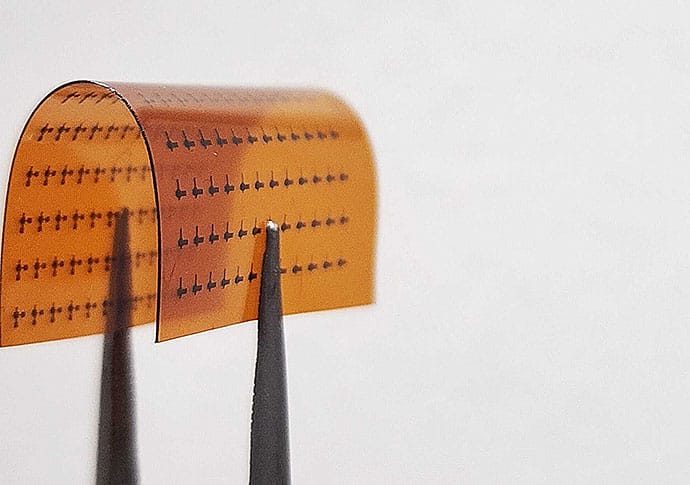
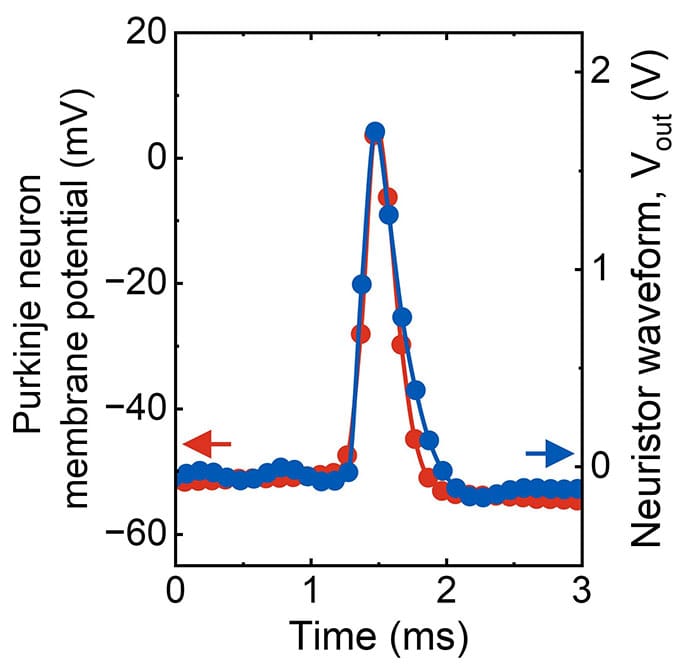
A team at Northwestern University has printed artificial neurons from molybdenum disulfide (MoS₂) — a semiconducting mineral — on flexible plastic that produce spiking waveforms closely matching biological action potentials in shape, width, and timing. When delivered to living Purkinje cells in mouse cerebellar tissue, the artificial spikes drove the cells to fire — the first demonstration that a printed device can produce electrical signals a real brain cell accepts and responds to.
The result, recently published in Nature Nanotechnology, could lay groundwork for a new generation of neural interfaces — prosthetic limbs that deliver realistic sensation, spinal cord bridges that relay motor commands, and benchtop disease models with tunable parameters.
“There’s this white space — organic devices are too slow, metal oxides are too fast — and biology lives in between,” said Mark C. Hersam, PhD, the study’s senior author and Walter P. Murphy Professor of Materials Science and Engineering at Northwestern University in Evanston, Illinois.
“We got these devices working at that timescale,” he said, “and when you have the right timescale and the right spike shape, you can directly interface with living cells.”
- Printed MoS2 artificial neurons generated action-potential-like spikes.
- Spike shape/timing matched biological APs; duration ≈0.7-2 ms.
- Mouse Purkinje cells fired to artificial spikes at <200 Hz.
- 740 Hz output failed; neuronal firing capacity limits response.
- Potential uses: neural interfaces, spinal bridges, tunable disease models.
Engineers Interface With Neuroscientists
The collaboration began not in biology but in electrical engineering. Hersam’s National Science Foundation grant aimed to build computing hardware that mimics the brain’s energy efficiency. The human brain runs on about 20 watts, whereas modern AI training runs on megawatts — a millionfold difference — and is extravagantly wasteful and potentially harmful to the environment.
The grant’s challenge: build computing hardware that mimics the brain’s efficiency.
“Most of the artificial neurons in the literature, if you actually look at their spiking profiles, they look more like a sine wave or just an oscillator, not a sharp action potential,” Hersam said. “They don’t achieve things like bursts of spikes, which is one of the things we demonstrate.”

But to mimic the brain, Hersam needed people who study it. He teamed up with Indira M. Raman, PhD, a neurophysiologist in the Department of Neurobiology at Northwestern University, and her lab. Her doctoral students, Spencer Brown, PhD, and Meghana Holla, PhD, visited Hersam’s lab to see what the engineers were up to.
The engineers in Hersam’s lab showed them the device output, with waveforms spiking at 3000 times per second, much too fast to mimic a neural cell. Purkinje cells may be among the fastest-firing neurons in the brain, but they only reach about 100 spikes per second.
“That’s not a neuron,” Brown, an incoming assistant professor of neuroscience at Brandeis University in Waltham, Massachusetts, recalled. “They can’t do that.”
Over the following year, both fields discovered they used identical terminology, such as long-term potentiation, memory, and synapse weight, to mean different things.

“We thought we were talking about the same things, but we weren’t,” Brown said.
Brown and Holla provided “ground truth”: Each spike had to last between a fraction of a millisecond and a few milliseconds, matching a real action potential.
And the firing rate — the number of spikes per second — had to fall between single digits and low hundreds, not the thousands the engineers’ devices had been producing.
The engineers took the neuroscientists’ advice and successfully reconfigured the circuit to match.
The Glue That Makes Artificial Neurons Fire
The artificial neurons are built from a liquid, a custom ink formulated for a specialized printer. MoS2, a semiconducting mineral, is peeled into flakes that are just a few atoms thick and suspended in ethanol. Without that suspension, the flakes clump together and settle out.
To keep them suspended, the researchers add ethylcellulose, a polymer derived from wood pulp, which coats each MoS2 flake and holds it apart from its neighbors, kind of like glue. The resulting ink is a stable suspension of semiconductor particles in solvent, and it flows through an aerosol jet printer that deposits it as a fine mist onto flexible plastic.
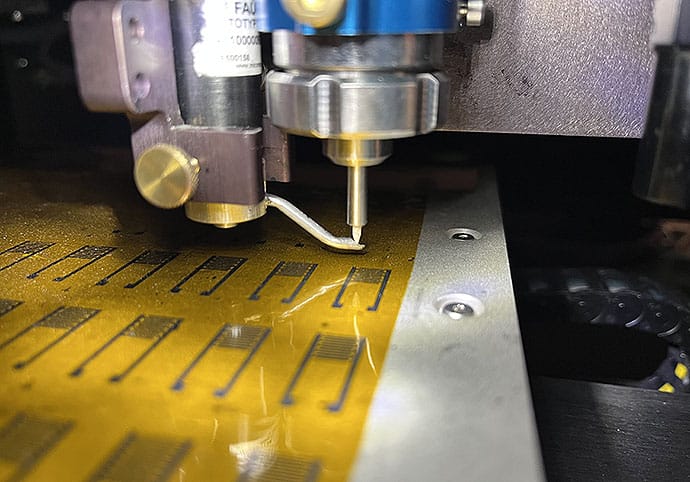
The ethylcellulose scaffolding is essential for the artificial neurons to communicate like a network. When the printed film is baked at 350 °C, the ethylcellulose partially decomposes into carbon residue that settles into tiny, nanometer-sized gaps between flakes to form conductive bridges. Once fabricated, the device operates at room temperature.
Then comes what’s called electroforming. The first time a large current passes through the device, it doesn’t flow evenly. Some pathways are slightly more conductive, such as wherever carbon residue accumulated more thickly, or wherever flakes overlapped. The more conductive pathways carry more current, and more current generates more heat. That heat decomposes more polymer residue into carbon along the same route, making it more conductive and drawing still more current toward it.

The result is a single dominant channel — a filament — burned through the thickness of the film. “This occurs in a spatially inhomogeneous manner, leading to the formation of a conductive filament…all the current constricted into a narrow region,” said Hersam.
The filament has two states: hot and conducting, or cool and nonconducting.
On its own, that’s just a switch. What turns it into something that fires like a neuron is the circuit around it.
“This is a random network of flakes with gaps of a few nanometers,” said Vinod K. Sangwan, PhD, co-corresponding author and research associate professor of materials science and engineering at Northwestern University. “You cannot have atoms going from one place to another across that vacuum. The only mechanism left is thermal.”
In the full artificial neuron, the printed switch sits alongside a capacitor, which is a component that stores electrical charge. A steady input current slowly charges the capacitor, the way a biological neuron gradually accumulates signals from its neighbors.
The filament heats up and becomes conductive, and the capacitor rapidly discharges through it. That sudden discharge is the spike — a sharp, fast voltage pulse. Then the filament cools, the switch resets, and the capacitor begins slowly charging again. The cycle repeats: slow accumulation, sudden firing, reset.
And because the filament heats and cools on a millisecond timescale, the spikes fall within the same timing window as a real neuronal action potential.
How Real Brain Cells Respond to Artificial Neurons
Holla, who completed her PhD in Raman’s lab and is now a postdoctoral researcher studying memory at New York University in New York City, designed and ran experiments in mouse cerebellar slices. She positioned a stimulation electrode on the parallel fibers, the main pathway that excites Purkinje cells, and a recording electrode on the Purkinje cells themselves.
She played recordings of the artificial neurons’ waveforms into the tissue through a standard stimulation electrode at four different speeds: 7, 60, 218, and 740 spikes per second.
At every speed below 200 spikes per second, the Purkinje cells fired in response. The strongest results came at 60 spikes per second, where each artificial spike lasted 0.7 milliseconds, which is fast enough to trigger the cell but brief enough to avoid flooding the tissue with unnecessary current.
Above 200 spikes per second, the cells stopped responding. They simply cannot fire that fast. The team included the 740-spikes-per-second condition on purpose to directly challenge the many engineering groups building artificial neurons that operate at those speeds. “We had to show them [740 spikes] wasn’t sufficient,” Brown said. “You can’t work that fast.”
“You can see the living neurons respond to our artificial neuron,” Hersam said. But he is careful to note a caveat: The printed artificial neurons were not touching the brain tissue. The waveforms they generated were recorded and then played back into the slice through standard laboratory stimulation equipment.
The next step is to prove the printed device itself can interface with living tissue.
Clinical Possibilities
Ian Gaudet, PhD, a neuroscientist at Florida Atlantic University in Boca Raton, Florida, who was not involved in the study, sees multiple clinical possibilities from this work.

“I’ve been waiting for [work like this] for years,” Gaudet said. “The signals coming off of these devices are the right shape, the right speed, and the right language for real neurons to be properly affected by them.”
The printed artificial neuron, he argues, is like a translator, converting digital information into electrical patterns neurons accept as input. And in prosthetic limbs, it could replace the rectangular pulses that give amputees a buzzing sensation with signals that peripheral nerves evolved to receive. A crude approximation of sensation could become something much closer to the real feeling.
“The idea would be to have this system where you’re controlling your prosthetic limb and you are feeling your prosthetic limb using the existing neuronal systems of your peripheral nervous system,” Gaudet said.
In spinal cord injury, it could convert decoded motor intentions into biologically shaped signals that motor neurons below a lesion treat as natural commands.
“If you can make that signal seamless,” Gaudet said, “people with spinal cord injuries could walk again one day.”
But where these artificial neurons may prove most valuable first is not as replacements for any damaged brain tissue but as test models. Researchers could build a small artificial cerebellar circuit on a benchtop, configure each element to fire like a different cell type, then deliberately break it to change the firing rate, and, in turn, simulate Purkinje cell loss in spinocerebellar ataxia.
Or one could remove an element to model a cerebellar stroke to see what happens — a disease model that could lead to novel treatments.
“You can turn this on, or turn this off,” Gaudet explained. “What happens if we mimic the patterns that we see in people who have a certain disease?”
Gaudet suggests researchers may use these devices as a physical disease model with real electrical dynamics.
What the Artificial Neuron Cannot Do
Hersam’s next goal is a small circuit — perhaps 10 artificial neurons — where each one fires differently, and together they accomplish what would require thousands of conventional transistors.
“Silicon achieves complexity by having billions of identical devices,” Hersam said. “The brain is the opposite. It’s heterogeneous. The complexity is at the device level.”
But Gaudet sees a gap no circuit design can yet fill: Biological neurons grow new connections and prune old ones, strengthening pathways that are used and weakening those that aren’t. Hersam’s lab’s printed neurons — or any other neuromorphic technology that mimics neuronal dynamics — can’t achieve that level of complexity yet.


No comments:
Post a Comment